
A small bedroom asks more of every decision — where the bed sits, which pieces earn a place, how the light falls. Get those choices right and even a box room or a room tucked under the eaves can feel calm, ordered and genuinely restful rather than cramped. Below are practical, tried-and-tested ways to make the most of a compact space, from layout and storage ideas, to colour, lighting and the finishing touches that pull it all together.
Panelling is one of the easiest ways to add character to a small room without losing space — see wood panels for walls for ideas on where and how to use it.

Where to put the bed
Bed placement decides everything else in a small room, so it’s worth getting right before any other choices are made.
- Against the longest wall. This usually clears the most floor space and leaves room either side for nightstands or a narrow chest.
- Centred under a window, if the room allows it — it can balance the space visually, though it’s worth checking that draughts or early light won’t disturb sleep.
- Tucked into a corner or under a sloped ceiling, which frees a full side of the room and creates a cosy, nook-like feel. This works particularly well in loft or attic rooms.
- Clear of the doorway, with an unobstructed path from door to bed — a room reads as far more spacious when nothing blocks the main route through it.

A bed pushed into an awkward eave or alcove, paired with a slim floor lamp and a tall mirror opposite, can make a genuinely small footprint feel considered rather than squeezed.

Storage that earns its keep
In a small bedroom, every piece of furniture should be doing more than one job — beds with hidden storage, wall-mounted shelving in place of floor-standing units, and going vertical wherever possible all help reclaim space that would otherwise sit empty.
For the full breakdown — 17 specific ideas covering ottoman beds, wardrobe organisation, under-bed storage and more — see small bedroom storage ideas.
Multi-functional furniture
When a bedroom is also a workspace, or the only spare room in the house, furniture needs to flex.
A loft or raised bed is one of the most effective small-bedroom moves available — elevating the sleeping area frees the entire footprint underneath for a desk, wardrobe or reading corner, without the room ever feeling cluttered. It’s a particularly good fit for a box room or a room doing double duty as a home office.

For rooms needing to convert completely between sleeping and working, a wall (Murphy) bed that folds away by day is worth considering — see the storage guide linked above for a specific model and how it works.

Colour and light
Colour has the fastest effect on how spacious a small bedroom feels.
- Light, reflective shades — soft whites, warm greys, gentle pastels — bounce daylight around the room and open it up visually. A stencilled or wallpapered headboard shape in a similar tone adds a focal point without a single inch of floor space lost.

- Minimal window treatments. Light, unlined curtains or simple blinds let in the maximum amount of natural light.
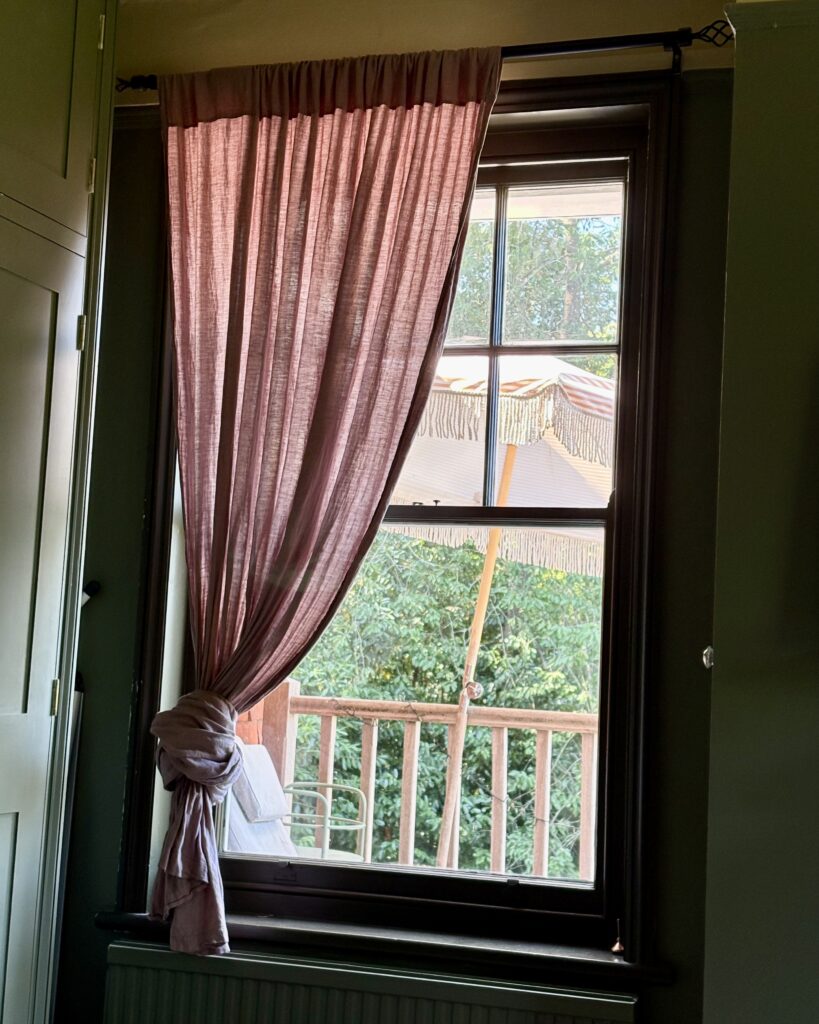
Pictured is the Vintage Rose 100% Linen Loop Top Curtain from Secret Linen Store. Pink and green is one of our favourite combinations — explore more ideas in pink and green room ideas.
- Large mirrors placed opposite a window bouncer daylight back into the room and make it feel noticeably bigger; a mirrored wardrobe front does the same job while adding storage.
Not every small bedroom needs to go light, though — a single deep, enveloping colour used across walls, woodwork and ceiling can work just as well, making the edges of the room recede rather than close in. A soft sea-blue like this pairs naturally with a coastal interior design look.
For a full breakdown of that technique and budget-friendly ways to apply it, see small bedroom ideas on a budget.

For colour inspiration by shade, the beige bedroom ideas and green and beige bedroom guides cover paired palettes that work well in compact rooms.
Lighting choices
A well-lit room reads as larger and more inviting, whatever its actual size.
- Layer the lighting — ambient, task and accent — rather than relying on a single central pendant, so the room adapts through the day.
- Wall-mounted or pendant lights beside the bed free up nightstand space entirely, which matters more the smaller the surface. The Anglepoise Type 80 W2 Wall Light in matte black is a good example — an adjustable reading light that takes up no surface space at all. For more ways to layer light in a small room, see lighting ideas for every room.

- Warm bulbs in the 2700–3000K range keep a compact room feeling cosy rather than clinical.
For low-cost ways to achieve this — including a bare-cable sconce that needs no fitting or electrician — see the budget-friendly bedroom guide linked above.
Declutter and finishing touches
A cluttered room feels smaller than it is, regardless of its actual dimensions.
- Keep only pieces that are used or loved — a small bedroom has no space for “just in case” items.
- Use wall hooks for bags, dressing gowns or jewellery rather than draping them over furniture.

- Choose a headboard as a focal point in place of wall art that needs its own clearance — it adds presence without taking up floor space.

- Bring in one plant or a small vase of flowers for warmth; a single considered object does more than several small ones scattered around.
FAQs
Where should a bed be placed in a small bedroom?
Against the longest wall usually maximises floor space and access. Centring the bed under a window can create a balanced look if the room allows it, and a corner placement frees up a full side of the room — useful for a single sleeper or where the far side of the bed doesn’t need daily access. Whichever position is chosen, leave a clear path from the door and enough room to move around the bed comfortably.
What colour makes a small bedroom look bigger?
Light, reflective shades — soft white, warm grey, gentle pastels — bounce daylight and make the walls feel further away. Keeping the same tone across walls and woodwork removes visual breaks that can make a room feel choppy and smaller than it is.
How can I add storage to a small bedroom without losing floor space?
Beds with built-in storage, wall-mounted shelving, and going vertical wherever possible all help. See small bedroom storage ideas for 17 specific ways to do this.
Does a small bedroom always need light colours?
No — a fully painted room in one deep, matte tone can make the edges of a small space recede, creating a cosy, enveloping feel rather than a boxed-in one. It suits a room used mainly for sleeping.
Further Reading
- Blue Bedroom Ideas: Inspiring Designs for a Stylish and Serene Space
- Cottage Bedroom Design Ideas: Cosy, Timeless and Inviting
- Creating a Chic Boho Bedroom