
Your hallway is the first and last thing anyone sees of your home, yet it’s often the room that gets the least design attention. Getting hallway decor right isn’t about grand gestures — it’s about layering colour, light, storage and a few well-chosen pieces so the space feels considered rather than accidental.
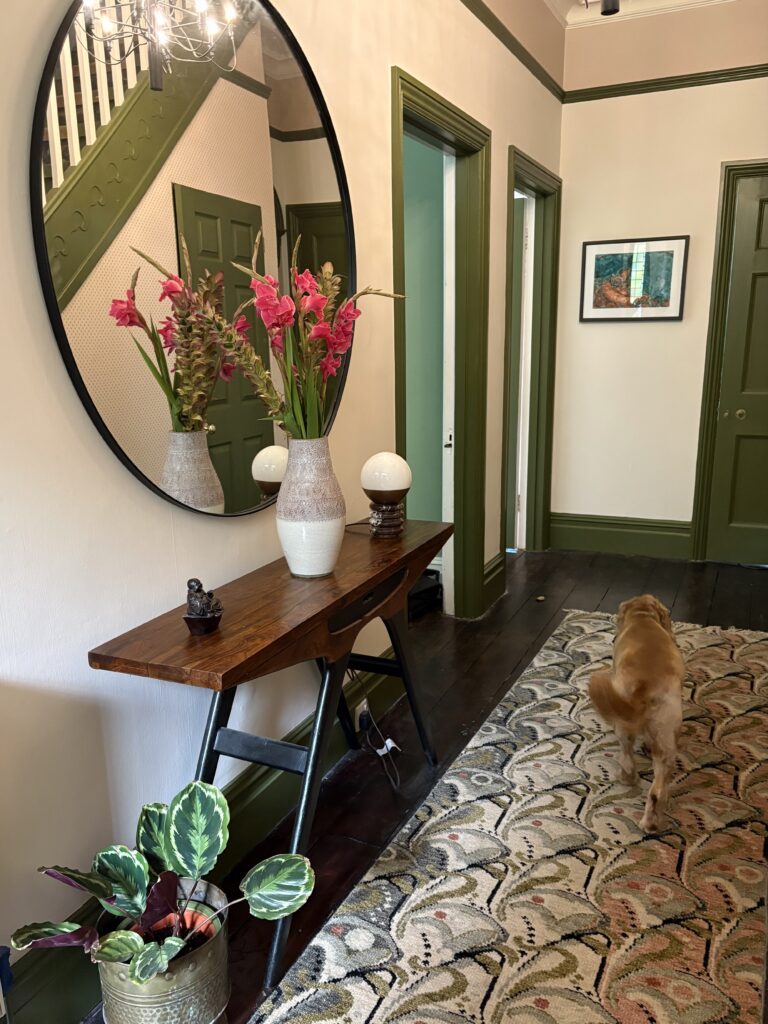
From the colour on the walls to the storage tucked under the stairs, every decision in a hallway earns its place twice over — once for how it looks, and once for how it holds up to daily use. Here’s how to think through each part of the space.
Colour and Paint
Colour does more work in a hallway than almost anywhere else in the house. Because hallways are typically glimpsed rather than lingered in, bolder colour choices that might feel overwhelming in a living room often work beautifully here — a deep green, ink blue or warm terracotta can turn a plain corridor into a genuine moment, especially paired with white woodwork for contrast. If terracotta and warm orange tones appeal, our guide to burnt orange home decor covers how to bring that warmth into a wider scheme beyond just the hallway.
If your hallway lacks natural light, stick to warmer, lighter tones that bounce light rather than absorb it — see our full guide on how to lighten a dark hallway with no natural light for more on tackling this specifically. Where there’s a run of doors leading off the hallway, painting the woodwork in a contrasting colour to the walls helps define the architecture rather than letting it disappear.


Soft pinks and warm terracottas suit hallways that get plenty of natural light, softening the space without making it feel cold — Setting Plaster is a gentle, barely-there pink, while Terre d’Egypte brings real warmth and works particularly well against timber flooring. If you’d like to take the warmth further, our guide to burgundy paint for walls covers how a deeper, richer red-toned colour can work in the same way.

Yellow is a confident choice for a hallway that lacks natural light — even a north-facing corridor picks up warmth from an ochre or mustard tone like India Yellow shown here, especially against timber panelling. For more on working with this shade elsewhere in the home, our guide to decorating with mustard yellow covers pairings and where it works best. The dark console table shown here also demonstrates how well black furniture grounds a bold colour scheme — see our guide to styling a black console table for more.


Pink and green is a pairing that works particularly well in a hallway, where the green door or woodwork can act as a grounding accent against a softer blush wall, as shown in both images here. Our guide to pink and green room ideas covers how to take this combination further across a whole scheme, not just a hallway.


Green has become the most reliably popular hallway colour of the last few years, and these examples show why it works across such different scales — from a single accent door in Churlish Green, to a full Breakfast Room Green entrance hall, to Bancha paired with a warmer neutral on the woodwork in our own hallway. It pairs naturally with the greenery and timber tones already common in an entrance space, and reads as calm rather than cold even in a darker, more traditional palette.
Wall Art and Mirrors

A hallway wall is one of the best places in the house for a gallery wall — visitors move slowly enough to take it in, but not so slowly that a large, single piece is required to hold their attention. Group smaller framed prints or photographs in a considered grid, or lean into one statement piece if your hallway is on the narrower side. For a broader look at pulling a scheme together, our guide to wall art ideas covers styles and placement beyond just the hallway.
A gallery wall works particularly well up a staircase, where the change in level naturally staggers the frames rather than requiring a perfectly level grid.

Mixing frame sizes and a few playful prints among more considered pieces, as shown here, keeps a stairwell gallery from feeling too formal. It’s worth knowing where to stop, though — see our guide on whether you can have too much wall art for where that line typically sits.
Mirrors do double duty in a hallway: they bounce light into what’s often a dim space, and they visually widen a narrow corridor. An oversized round or arched mirror above a console table is a reliable formula that works in almost any style of home.
Form & Refine A Line Mirror

Shop at Holloways of Ludlow
York Rectangular Mirror

Lighting
Lighting changes a hallway more than almost any other single decision. Layering an overhead fixture with wall lights avoids the flat, single-source lighting that leaves the ends of a hallway in shadow — see our full guide to hallway lighting ideas for pendant, flush mount and wall light options suited to different ceiling heights and hallway widths.
Furniture: Console Tables and Storage

A console table is the anchor piece of most hallways — somewhere to land keys and post, and a surface for styling with a lamp, mirror and a vase of flowers. Rustic, reclaimed timber console tables bring warmth to a period hallway, while a black metal-framed table reads as a graphic, contemporary anchor — see our guide to black console table ideas for styling inspiration.


Notice how differently each is styled, too — the oak console keeps things simple with a single lamp and print, while the marble piece brings in a lamp, bowl and vase together for a fuller, more layered look. Both approaches work; it’s really about matching the styling density to the rest of your hallway.
Storage matters just as much as styling. Hallway shoe storage and coat hooks keep the entrance functional day to day, and if your hallway has a staircase, the awkward triangular space beneath it is worth putting to work — our guide to under stairs storage ideas covers pull-out drawers, cupboards and bespoke solutions for that wasted void. For storage solutions across the rest of the home, our storage ideas hub covers every room.

Coat storage deserves the same thought as shoe storage. A rack with an integrated shelf gives you hanging space plus a surface for keys, gloves or post in one piece, like the reclaimed scaffold board design below. If you’d rather keep the wall looking clean when it’s not in use, a flip-down design folds flat against the wall until you need it.


Flooring and Runners

Hallway flooring needs to handle more daily traffic than almost any other room, so hard-wearing materials — stone, tile, or engineered wood — are worth the investment over softer options. A runner rug softens the space underfoot, adds colour and pattern, and helps draw the eye down a long, narrow hallway rather than letting it feel like a corridor to rush through.

A washable runner is worth considering if your hallway sees daily use from muddy boots or pets — the Tartan Paw design shown here holds its pattern well against the kind of stone flooring common in period entrances, and being washable means it can handle real traffic rather than just looking the part.

A striped runner in a soft, muted palette — pink, sage and cream here — suits a cottage or country-style hallway, particularly one that doubles as a boot room with coat hooks and welly storage. The stripe direction also helps draw the eye down a long, narrow hallway.
Panelling and Wall Treatments
Panelling is one of the most effective ways to protect hallway walls from the daily scuffs of pushchairs, bags and dog leads while adding real architectural character. Half-height panelling paired with a contrasting paint colour above is a classic, versatile combination — see our full guide to hallway panelling ideas for styles and how to fit them.
Styling Touches
Once the bigger decisions are made, it’s the small details that make a hallway feel finished: a woven basket for umbrellas or wellies, a trailing plant to soften a corner, a stack of well-loved books on the console table shelf. Resist the urge to overfill the space — a hallway is a transition, and a few well-chosen pieces read as more considered than a crowded surface.
FAQs
What decor works best in a small hallway?
Keep furniture slim and wall-mounted where possible — a narrow console table or floating shelf rather than anything freestanding and bulky. Light, neutral wall colours and a large mirror both help a small hallway feel more open, and a runner rug adds warmth without eating into the width of the space.
How do I add personality to a plain hallway?
Colour, art and lighting are the three fastest routes to personality. A bold paint colour or wallpaper on just one wall, a gallery of framed prints, or a statement pendant light can transform a plain hallway without any structural changes.
Does a hallway need a runner?
It’s not essential, but a runner softens hard flooring underfoot, protects it from daily wear, and adds colour and pattern to what’s often a fairly neutral space. In a long, narrow hallway, a runner also helps draw the eye down the length of the room.