
Japan’s garden tradition is built on restraint, symbolism and a profound respect for the natural world. The good news for UK gardeners is that many of the plants central to that tradition are remarkably well-suited to the British climate — tolerant of cool, damp conditions and perfectly at home in our acid soils.
This guide covers the essential Japanese garden plants for UK growing conditions, from the flame-bright foliage of acers to the architectural calm of bamboo, with advice on where to place them and how to let them do the work. Whether starting from scratch or refreshing an existing scheme, these are the plants that will carry the look.

Japanese Maple
Japanese maples (Acer palmatum) are the cornerstone of Japanese garden planting — valued for their delicate, deeply lobed foliage, their layered branching habit, and autumn colour that ranges from soft gold through to burning crimson. In the UK they perform beautifully, particularly in the acid, moisture-retentive soils of the south and west.

They prefer a sheltered spot with dappled light — full sun can scorch the more delicate dissectum varieties, and exposed positions will shred the fine foliage in wind. Mulching with bark or leaf mould helps retain moisture and protects the shallow root system through winter.
Reliable varieties for UK gardens include Acer palmatum ‘Atropurpureum’, with its rich burgundy foliage turning crimson in autumn; ‘Sango-kaku’ (Coral Bark Maple), grown as much for its striking coral-red winter stems as its yellow autumn leaves; ‘Osakazuki’, considered one of the finest for autumn colour; ‘Bloodgood’, dependably deep burgundy through the season; and the weeping dissectum forms such as ‘Viridis’ and ‘Crimson Queen’, which bring a graceful, cascading habit to borders and containers.
Bamboo
Few plants create atmosphere in a Japanese garden as quickly and effectively as bamboo. The movement of the canes in a light breeze, the rustling of the leaves, the vertical structure — all of it contributes to the sense of enclosure and calm that defines the style.

The key consideration for UK gardens is choosing between running and clumping varieties. Running bamboos spread via underground rhizomes and can become very difficult to manage without root barriers. Clumping varieties expand slowly from a central crown and are far more garden-friendly.
For most UK gardens, Fargesia murielae (Umbrella Bamboo) and Fargesia nitida (Fountain Bamboo) are the most practical choices — both clump-forming, both tolerant of shade, and neither aggressive. For a more dramatic effect, Phyllostachys nigra (Black Bamboo) is worth considering for its striking near-black culms, though it will need a root barrier or container to keep it in check. Phyllostachys aurea (Golden Bamboo) and Semiarundinaria fastuosa (Temple Bamboo) are also hardy in the UK and suit larger spaces where some spread can be accommodated.
All bamboos prefer reasonable drainage and dislike sitting in waterlogged soil over winter. A sheltered position will protect the foliage and prevent wind damage to the canes. Bamboo works particularly well in gravel garden ideas — the contrast between the vertical canes and a raked gravel surface is one of the defining images of Japanese garden design. In gravel gardens with pots, clumping varieties like Fargesia are an excellent choice, contained and architectural without the risk of spreading into the gravel.
Cherry trees
Cherry trees — Sakura in Japanese — carry enormous cultural weight in the Japanese garden tradition, representing the transient beauty of life through their brief but spectacular flowering season. In the UK they are fully at home, and a well-chosen cultivar will stop the garden in its tracks each spring.

They need a sunny, open position and well-drained soil. Most are low-maintenance once established, requiring only light pruning after flowering if needed. Underplanting with hostas or ferns adds the layered planting typical of Japanese garden design.
Prunus ‘Kanzan’ is the most widely planted UK cultivar — vigorous, hardy, and covered in deep pink double flowers each April. Prunus ‘Shirotae’ (Mount Fuji) has fragrant white blooms and a wide, spreading habit, ideal for creating shade. Prunus ‘Amanogawa’ is columnar in form and excellent for narrow spaces. For year-round interest, Prunus x subhirtella ‘Autumnalis’ flowers intermittently through winter and spring on bare branches, and Prunus incisa ‘Kojo-no-mai’ is a compact, twisting-branched variety suited to containers or small gardens.
Azaleas
Azaleas are a staple of Japanese garden planting, used en masse in the great gardens of Kyoto and adapted beautifully to UK conditions. They flower in late spring, prefer acid soil, and thrive in the partial shade of a woodland-edge planting scheme — exactly the conditions that a canopy of Japanese maples and cherries creates.

Plant in well-drained, organic-rich soil and mulch annually with leaf mould or pine bark to maintain acidity and moisture. Avoid exposed positions and waterlogged ground.
Good UK varieties include Rhododendron ‘Geisha Orange’, a compact evergreen with vivid orange flowers; Rhododendron luteum, the deciduous species azalea with highly fragrant yellow flowers and full UK hardiness; Rhododendron ‘Hinodegiri’, a popular evergreen with bright red flowers that suits smaller spaces; and the Northern Lights series, bred specifically for cold hardiness, which includes Rhododendron ‘Rosy Lights’ with its warm pink blooms.
Hostas
Hostas are the workhorses of the Japanese garden understorey — shade-tolerant, structural, and available in a range of leaf sizes, colours and textures that allow for sophisticated planting combinations. Their broad, ribbed leaves contrast well with the fine texture of ferns and grasses, and they emerge reliably each spring to fill gaps left by deciduous plants.
They perform best in moist, humus-rich soil in partial to full shade. In the UK, slugs and snails are the main challenge — copper rings, grit mulch and slug-resistant varieties all help.
Reliable choices include Hosta ‘Halcyon’ (blue-grey foliage, known for slug resistance), ‘Sum and Substance’ (very large chartreuse to gold leaves, best with some morning sun), ‘Patriot’ (green with clean white margins), and the miniature ‘Blue Mouse Ears’ for containers and edging. For bold scale, Hosta ‘Empress Wu’ is one of the largest available and makes a dramatic statement beneath mature trees.
Fatsia japonica
Fatsia japonica — Japanese aralia — is one of the most useful evergreen shrubs for a Japanese-style garden in the UK. Its large, deeply lobed, glossy leaves bring bold architectural structure to shaded spots where little else performs so well, and it produces creamy white flower clusters in autumn that add late-season interest when most other plants are winding down.

It is fully hardy, low maintenance, and tolerant of deep shade, urban pollution and coastal conditions. In a Japanese garden context it works particularly well as a backdrop plant — providing dark evergreen mass behind hostas, ferns and Japanese forest grass, and maintaining the garden’s structure and depth through winter when the deciduous plants are bare.
Japanese iris
Japanese iris (Iris ensata, also known as hanashōbu) produces some of the most spectacular flowers of any hardy perennial — large, flat blooms in shades of purple, violet, white and pink, held above upright, sword-like foliage in midsummer.

They thrive in moist, acid soil and full sun to partial shade, making them ideal for planting at the margins of a pond or in a dedicated bog garden. They differ from the more common bearded iris in preferring wet rather than dry conditions, and they resent lime in the soil.
Suitable cultivars for UK gardens include ‘Rose Queen’ with elegant rose-pink blooms, ‘Variegata’ which offers both variegated foliage and deep blue-purple flowers, and ‘Kumoinogan’ with large white flowers and a yellow signal that provides a bright focal point among darker planting. Japanese iris works beautifully alongside other pond margin plants — see the guides to natural garden ponds and water plants for ponds for ideas on building out the full waterside planting scheme.
Ferns
The damp, mild climate of the UK suits ferns extremely well, and they are among the most useful plants for creating the layered, naturalistic understorey of a Japanese garden. Their soft, arching fronds contrast with the harder lines of stone and gravel, and many are evergreen, providing structure through winter.
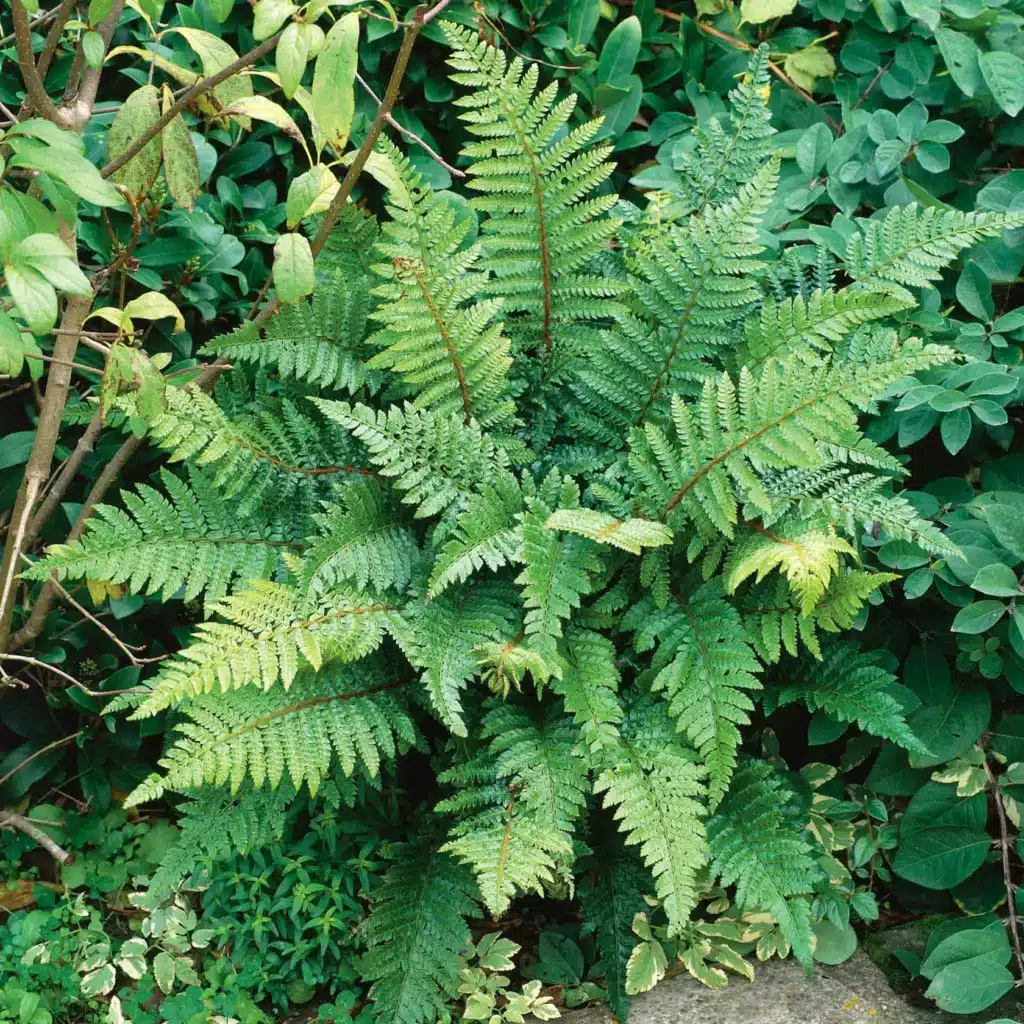
They thrive in shade and consistent moisture, making them natural companions for hostas and acers.
Dryopteris filix-mas (Male Fern) is robust and reliably deciduous with elegant shuttlecock-shaped crowns. Polystichum setiferum (Soft Shield Fern) is evergreen, feathery, and one of the most beautiful native ferns. Athyrium niponicum (Japanese Painted Fern) brings genuine ornamental value with its silver and burgundy variegated fronds — it is the most distinctly Japanese in character of all the hardy ferns. Osmunda regalis (Royal Fern) is majestic in scale and prefers wetter conditions, suiting pond margins or boggy areas.
Japanese forest grass
Hakonechloa macra (Japanese forest grass) is an ornamental grass with a graceful, arching habit that softens borders and path edges beautifully. It moves well in the slightest breeze, adding lightness and rhythm to a planting scheme that can otherwise skew heavy with foliage texture.
It prefers partial shade and moist, well-drained soil. The most widely grown form is Hakonechloa macra ‘Aureola’, with bright gold and green variegated leaves that illuminate darker corners. For a bolder effect, Imperata cylindrica ‘Red Baron’ (Japanese Blood Grass) offers deep red tones that intensify through the season and contrast dramatically with stone, gravel and the greens of surrounding planting.

Moss
Moss is one of the defining features of traditional Japanese gardens, used to convey age, permanence and a deep quiet that no other plant achieves in quite the same way. In the UK, where damp conditions are rarely in short supply, moss establishes readily without much encouragement.
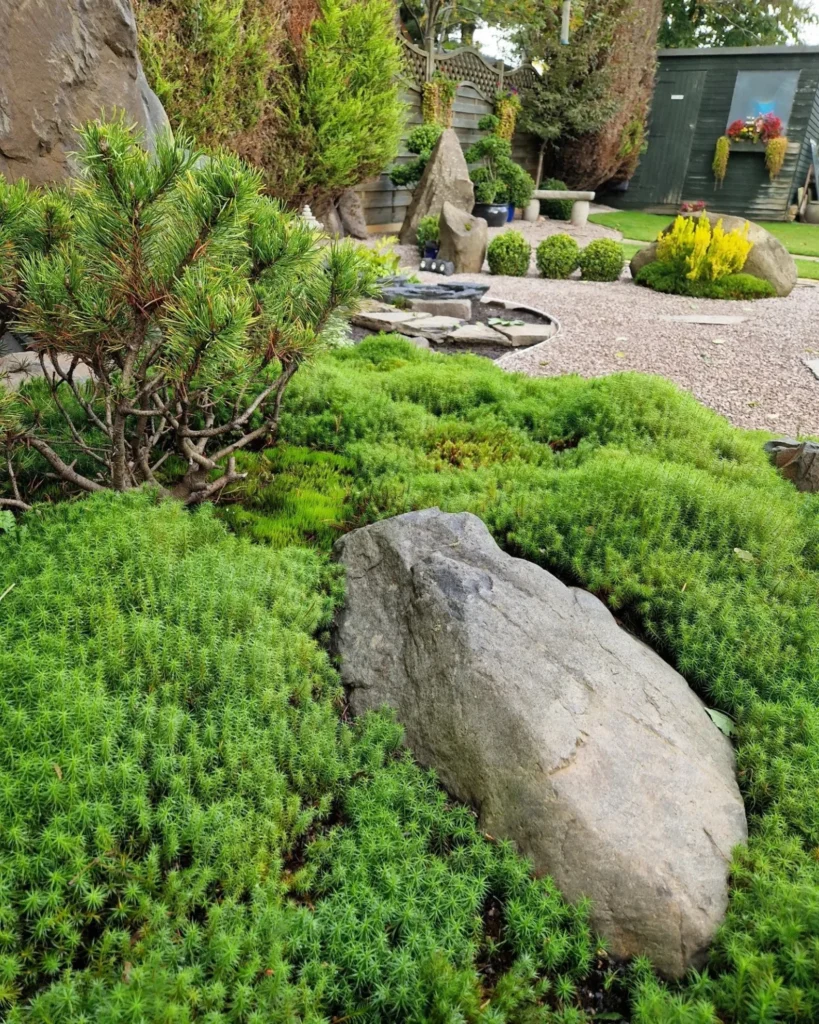
Varieties including Hypnum, Bryum and Racomitrium will form dense green carpets in shaded, consistently moist areas. Moss works particularly well beneath canopy trees, over stone, and beside water features. Rather than fighting its natural inclination to colonise these spaces, a Japanese garden approach is to welcome it — removing competing weeds and allowing the moss to spread at its own pace.
Plants mistaken for Japanese knotweed

Japanese knotweed (Reynoutria japonica) is one of the most misidentified plants in the UK, and the consequences of getting it wrong can be significant — from mortgage complications to costly removal programmes. Several common garden plants share enough visual similarity to cause genuine confusion, particularly in spring when new growth emerges quickly.

Bindweed (Calystegia sepium) produces heart-shaped leaves on twining stems that can resemble young knotweed shoots. The key difference is habit: bindweed climbs and twines, while knotweed grows in dense upright canes. Bindweed flowers are trumpet-shaped, white or pale pink.

Houttuynia cordata is a spreading ground-cover plant with heart-shaped leaves sometimes mistaken for knotweed seedlings. It is far smaller at maturity — rarely exceeding 30cm — and has a distinctive fishy scent when the leaves are crushed. The variegated form ‘Chameleon’ is commonly sold in garden centres.

Himalayan honeysuckle (Leycesteria formosa) has hollow, bamboo-like green stems with distinct nodes that are a frequent source of confusion. The leaves are larger and more pointed than knotweed, however, and the plant produces distinctive dangling flower racemes in late summer followed by deep purple berries.
Broadleaved dock (Rumex obtusifolius) can be confused with knotweed seedlings in spring, particularly the broad, somewhat heart-shaped emerging leaves. Dock grows as a rosette rather than in upright canes and does not spread via rhizomes.
Russian vine (Fallopia baldschuanica) is in the same plant family as Japanese knotweed (Polygonaceae) and shares similar heart-shaped leaves. It is a climber, however, producing masses of small white flowers in late summer, and is not subject to knotweed legislation.

How to identify Japanese knotweed with certainty: look for the combination of hollow, bamboo-like canes with purple-speckled nodes; shield-shaped leaves with a flat rather than tapered or rounded base, arranged in a zigzag pattern along the stem; and spring growth that emerges as red-purple asparagus-like shoots. If there is any doubt, the RHS and the Environment Agency both provide identification resources, and a professional survey is advisable before taking any action.
Japanese garden style and design
The plants are only part of the picture. Japanese garden design is guided by principles of balance, restraint and borrowed scenery — the idea that the garden should feel like a natural landscape distilled rather than imposed. Rocks, gravel, water and structure work alongside planting to create something that reads as complete rather than merely decorated.
Stone, water and structure are the three non-negotiable elements. Rocks placed with intention, a water feature however modest, and a pathway that guides movement through the space — these create the framework that the planting sits within. Asymmetry is deliberate, simplicity is the goal, and negative space is treated as a design element in its own right.
If you are drawn to the more meditative end of the spectrum, the guide to creating a Japanese zen garden in the UK covers the philosophy, materials and layout in detail, including how to achieve the look in a smaller space.
FAQs
What are the three essential elements of a Japanese garden?
Water, rocks and plants form the foundation of every Japanese garden. Water represents purity and fluidity, present as a pond, stream or stone basin. Rocks provide the structural framework, positioned to suggest natural landscapes. Plants are chosen for their seasonal changes and symbolic associations — evergreens for endurance, flowering trees and shrubs for the transient nature of life.
What are the basic design rules for a Japanese garden?
The key principles are asymmetry (Fukinsei), simplicity (Kanso) and enclosure (Miegakure). Asymmetry creates a natural rather than contrived appearance. Simplicity means restraint — a few well-chosen elements rather than abundance. Enclosure uses strategic planting, bamboo or fencing to create partial concealment that encourages exploration. Borrowed scenery (Shakkei) incorporates views beyond the garden boundary into the overall composition.
How do I create a Japanese garden on a budget?
Focus on a few key elements rather than trying to replicate everything at once. Locally sourced stone, a simple bamboo water spout into a small basin, and a planting scheme based on ferns, hostas and a single Japanese maple will establish the character of the style without significant outlay. Many of the most important plants — ferns, moss, hostas — are affordable and fast to establish. Gravel or reclaimed stone makes an effective path. The minimalist nature of Japanese design means that restraint is always the right choice.
Which Japanese garden plants are best for small UK gardens?
For small spaces, choose compact or slow-growing forms. Acer palmatum ‘Bloodgood’ or the weeping dissectum varieties stay manageable for years. Prunus ‘Amanogawa’ is columnar and takes minimal ground space. Fargesia murielae (Umbrella Bamboo) forms a clump without spreading. Hostas and ferns work well in containers if ground space is limited. A single well-placed Japanese maple, a patch of moss and a stone basin can be enough to establish the feeling of the style in even a small courtyard.
More inspiration

Natural garden ponds
How to design and build a naturalistic pond that works beautifully with Japanese garden planting.

Water plants for ponds
The best pond margin and aquatic plants for a naturalistic water feature in a UK garden.

Japanese zen garden
A detailed guide to the dry landscape style — gravel, stone, planting and structure for a UK garden.