
Patterned accent chairs do something a plain upholstered seat never quite manages: they make a room feel edited. One well-chosen chair — floral, geometric, striped or botanical — can anchor a living room, animate a bedroom corner or transform a hallway from functional to finished.
This guide moves through the main pattern families — what each one brings to a room, which shapes carry them best, and how to keep the wider scheme feeling considered rather than busy. Whether the starting point is a bold statement or something more quietly decorative, there’s a living room idea in here for every style of home.
Jump to a section
- Floral patterned accent chairs
- Geometric and graphic patterned chairs
- Striped accent chairs
- Velvet and textured patterned chairs
- Animal Print Accent Chairs
- Black patterned accent chairs
- How to style a patterned accent chair
- FAQ
Floral Patterned Accent Chairs

A one-of-a-kind maximalist piece with hot pink velvet and hand-painted blooms

Deep-buttoned and hand-crafted, with arts and crafts florals for a timeless look

Painterly blooms in rich velvet on a retro swivel base, with bold colour to match
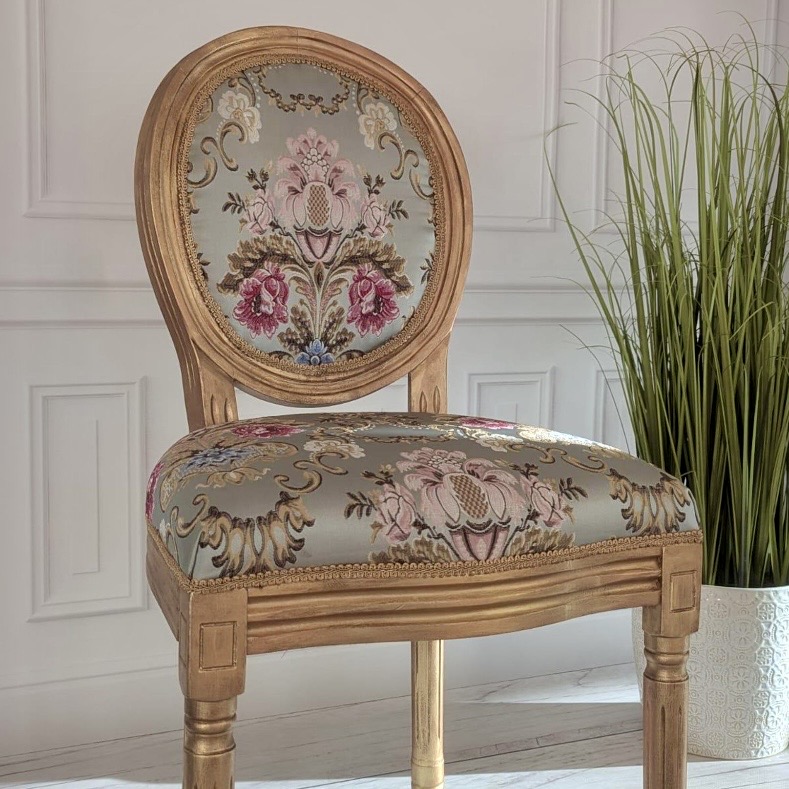
Rose brocade on a gilded Louis XVI frame, pure Parisian romance for a bedroom corner
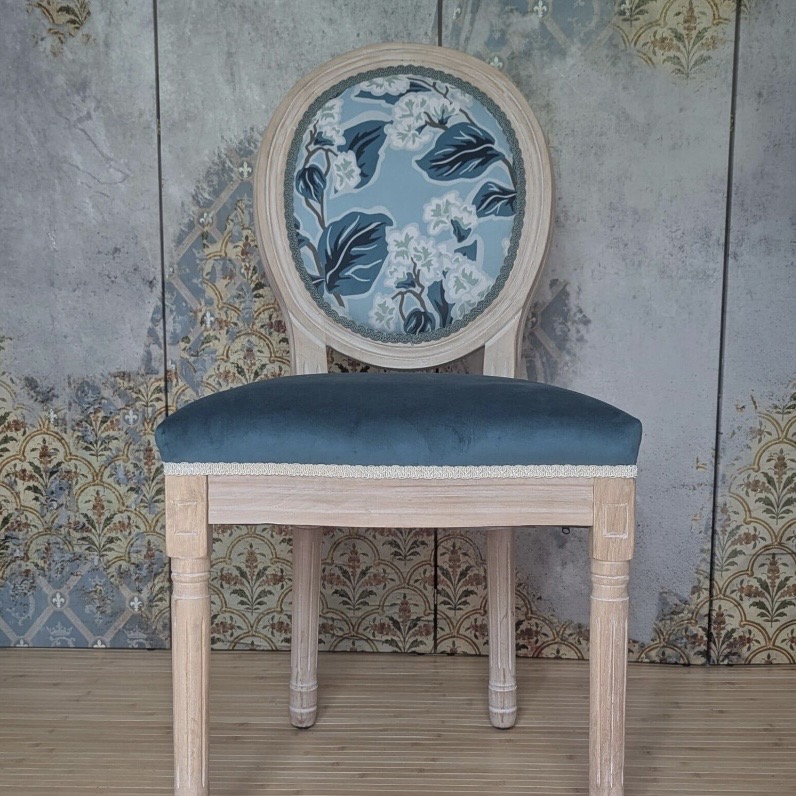
Blue botanical print paired with teal velvet on a limed oak frame
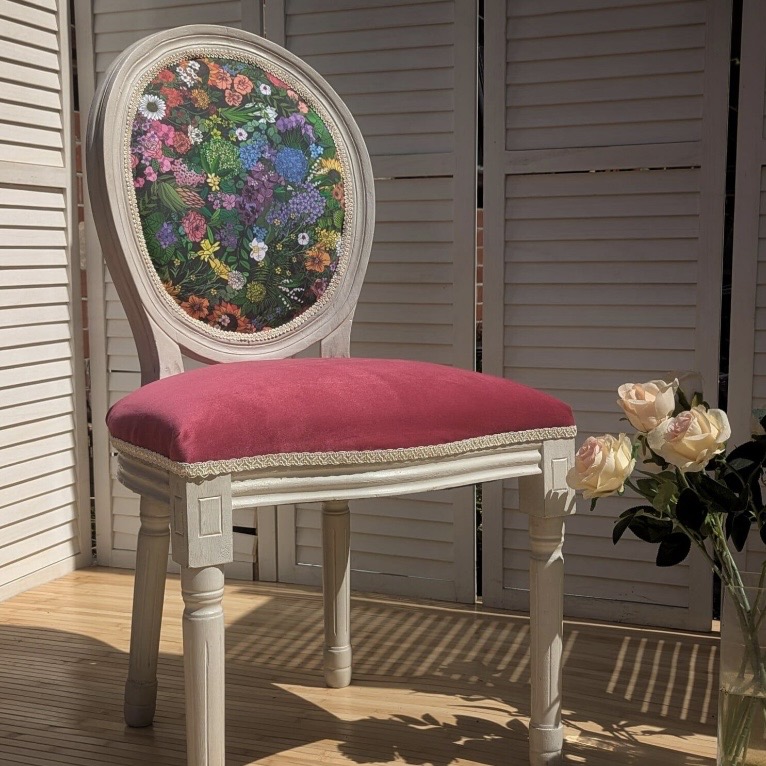
A riot of painterly blooms on a dark ground, with a raspberry velvet seat
Seeing a chair on its own only tells you half the story. How a floral works depends on what surrounds it: the wall colour, the rug and the other patterns in play. This room shows what happens when a floral chair is layered into a scheme rather than set apart from it. Here it sits alongside blue-and-white ginger jars and a lacquered cabinet, pieces straight out of the chinoiserie decor ideas playbook.

Floral upholstery has never really gone out of fashion — it’s just moved registers. Where once it meant chintz and cottage grandeur, today’s floral accent chairs are as likely to be oversized and graphic as they are delicate and traditional. The key is in the ground colour: a cream or ivory base reads softer and more heritage-inflected; a dark background — black, ink or charcoal — gives the same floral motif a sharper, more modern edge.
This Pointing and All White room shows floral upholstery operating at full confidence. The red and white floral chair isn’t trying to stand out — it’s part of a deliberate accumulation of pattern, colour and object that reads as curated rather than chaotic. The chair’s ground colour ties it to the Persian rug beneath; the red picks up the sofa opposite. In a room this layered, pattern cohesion comes from colour repetition rather than restraint.
Wingback and tub shapes carry florals particularly well, giving the pattern a frame and a sense of occasion. For smaller rooms, a more compact barrel chair in a contained floral print — think scattered sprigs rather than full-blown cabbage roses — brings pattern without visual noise.
Styling note: If you’re not layering pattern as confidently as the room above, let the floral chair be the only pattern in the room. Keep the sofa, curtains and rug in solids or subtle textures, and pull a single colour from the chair’s ground into a cushion or throw to tie the scheme together.
Geometric and Graphic Patterned Accent Chairs

Painterly colour-block stripes with a teal velvet seat, modern geometry on a French frame

Gold cranes on black crushed velvet, framed in gilt for pure Deco glamour

Bold ikat diamonds in blue, red and mustard on linen, with deep buttoning and turned legs
Geometric upholstery is the sharpest tool in the patterned accent chair kit. Diamond weaves, bold checks, abstract repeat prints and chunky jacquards all belong here — patterns built on repetition and structure rather than representation. They read confidently in contemporary and mid-century schemes, and particularly suit rooms already leaning towards clean lines and restrained colour.

The indigo diamond chair against Hague Blue walls is a lesson in how geometric pattern and bold colour interact: the chair’s graphic quality is amplified rather than lost against a strong backdrop, because both are working with the same logic of defined edges and deliberate contrast. It’s the same principle behind styling a bright coloured sofa — pattern and boldness read best when they’re not fighting each other for attention.

In lighter rooms, geometric chairs bring structure without weight. Against Parma Gray, the ikat-pattern chair reads as the room’s focal point — the kite print artworks on the wall echoing its graphic sensibility without competing directly.
Geometric chairs reward contrast. Pair them with softer, organic shapes — a round side table, a jute rug, a curved lamp base — to keep the overall mood from feeling too hard-edged.

The warm rust sofa and kilim-patterned accent chair show how pattern and colour can share a room without competing — each anchoring a different corner, unified by the earthy palette. If this combination appeals, our burnt orange home decor guide covers the full colour story, and our orange living room ideas show more ways to build a full scheme around it. The ribbed coffee table and orange cushions complete the look.
Styling note: With a bold geometric chair, restraint elsewhere is not a compromise — it’s the plan. One strong pattern needs a quiet room behind it.
Shop the Look
Arte Armchair
A woven rag-rug fabric in a bold, kilim-inspired geometric print, finished with tapered wooden legs and brass stud detailing. The graphic pattern reads as confidently in a contemporary living room as it does alongside more traditional pieces — proof that a strong print doesn’t need to be paired with plain solids to feel considered.
Under £600
Shop at Atkin and Thyme
Striped and Check Accent Chairs

Bold rust and navy stripes on a curved timber frame, with warm, woven, mid-century charm

French country charm in black gingham with brass stud trim, perfect beside a dressing table

Tonal stripes in a textured weave, finished with stud trim and oak arms
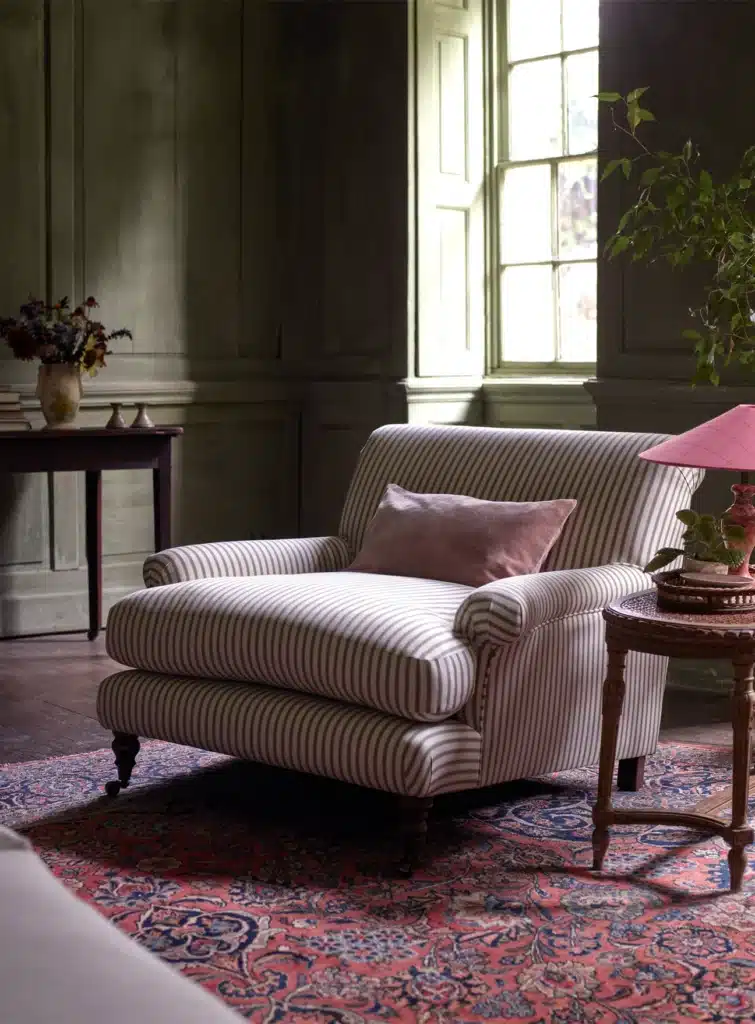
Striped fabric is the most versatile of pattern families — it works in traditional and contemporary rooms alike, and it’s the easiest to mix with other pattern types without creating visual chaos. Bold wide stripes give a chair a graphic, almost fashion-editorial quality; narrower ticking stripes in cream and taupe read quieter and more heritage in feel.
The scale and direction of the stripe changes everything. A deep, generous armchair in a narrow ticking stripe — like the Remy in sage — feels considered and grown-up. The same chair in a bold wide stripe would read as a statement piece in an entirely different register.
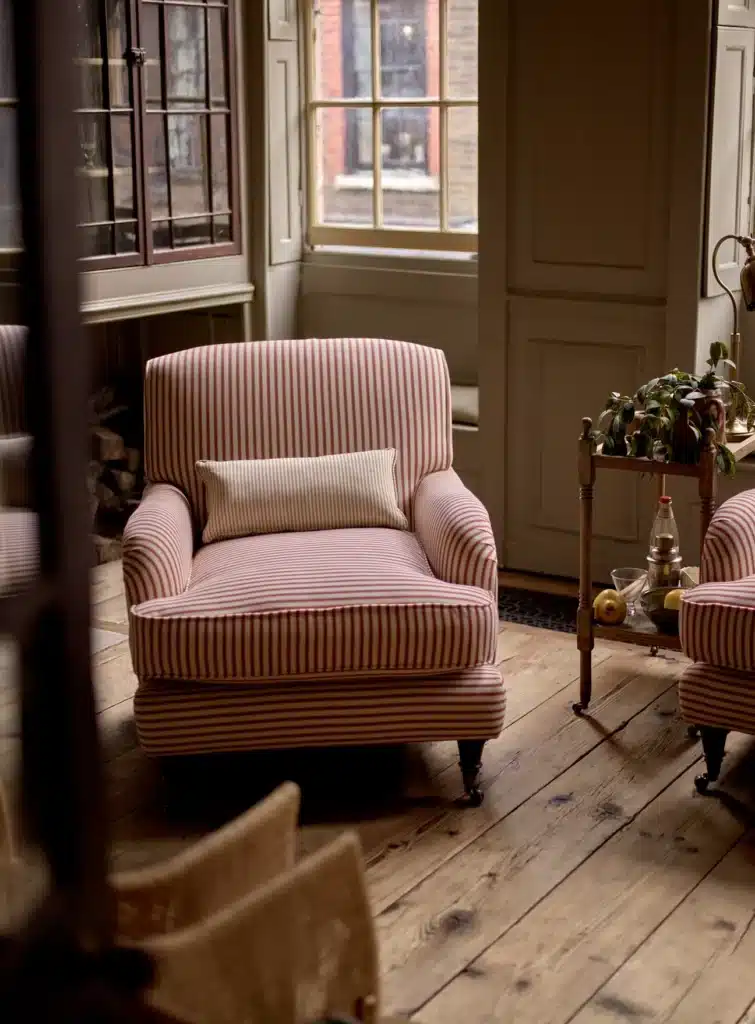
Heritage red ticking is one of the most enduring stripe colourways in British interiors — warm enough to anchor a neutral room, graphic enough to hold its own against pattern and colour. Paired in a window bay or flanking a fireplace, two matching striped chairs create a sense of considered arrangement without feeling formal.
Checks sit naturally alongside stripes — both are built on grid and repetition, which means they share a visual logic even when the scale and colour differ. The yellow tray anchoring the ottoman above is a small but telling detail — see our coffee table décor ideas for more ways to style a surface like this.

Striped chairs also solve a specific decorating problem: they add visual interest without committing to a complex motif, which makes them an easier choice for rooms where other decorating decisions are still in progress. It’s the same instinct behind a colourful coffee table — one confident, characterful piece doing the work so everything else can stay calm.
Styling note: Horizontal stripes tend to make a chair look wider and more relaxed; vertical stripes give the illusion of height and formality. Worth considering before committing to a fabric direction.
Velvet and Textured Patterned Chairs

Pattern doesn’t have to be printed. Boucle, jacquard, rattan weave and embossed velvet all carry pattern through structure and surface rather than ink — and in a well-dressed room, the effect can be just as strong. These are chairs that reward proximity: the closer you get, the more there is to look at.
Boucle and loop-pile fabrics sit particularly well in traditional and heritage-inflected rooms. Here, a cream boucle chair holds its own against Charleston Gray walls and Wisteria Wallpaper — the tight, tactile surface reading as texture from across the room and pattern up close. It’s one of the more versatile choices for spaces that want interest without visual noise.
Rattan and cane weave bring a different kind of surface pattern — open, geometric and light. Against Purbeck Stone with its graphic pencil-line wall detailing, a mid-century rattan shell chair feels considered rather than casual — proof that the right backdrop can elevate the simplest of materials.

Styling note: Textured and woven chairs attract and hold light differently across the day. Worth viewing in the room’s actual light before committing — particularly in north-facing spaces where a pale boucle can look flat, or a dark rattan can disappear entirely.
Shop by Colour
The Black Edit
Black patterned accent chairs come in so many moods — from bold geometrics to delicate florals and textural woven designs. If you love the graphic impact of monochrome seating but want something slightly different in scale or silhouette, these options offer plenty of personality while keeping that grounded, dramatic feel.
The moodboard below shows how these elements work together — tonal, considered and unapologetically graphic.

Shop the Look
Want to recreate the same graphic contrast and tonal layering? Here are the exact pieces used in this black patterned accent chair moodboard.
- Shop GUBI Pacha Lounge Chair — Karakorum Stripe / Black Base Swivel
- Shop HAY Can 3+ Seater Sofa — Chromed Steel with Linara FR 311 Fabric
- Shop Miniforms Soda Round Side Table — Orange
- Shop HAY Peas Random Rug — Cream / 140 × 200cm
- Shop GUBI Démon Shelf — Black Stained Ash / 3-5 Shelves
- Shop GUBI Multi-Lite Floor Lamp — All Chrome
- Shop Monochrome Beauties Art Print — Framed
Availability can change — double-check your measurements before you buy.
The Pacha is the centrepiece of the scheme — and in a room, it earns that position.
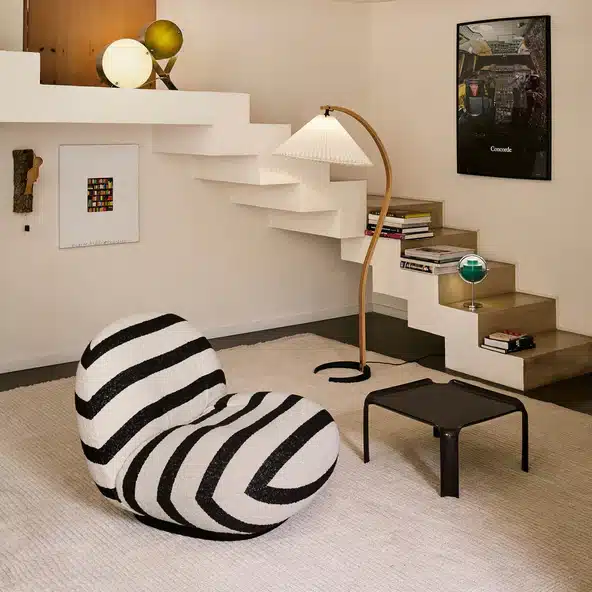
If the Pacha sits at the sculptural end of the spectrum, these three chairs offer different ways into the same black patterned brief — from illustrated print to bold diagonal stripe.


More Black Patterned Accent Chairs We Love

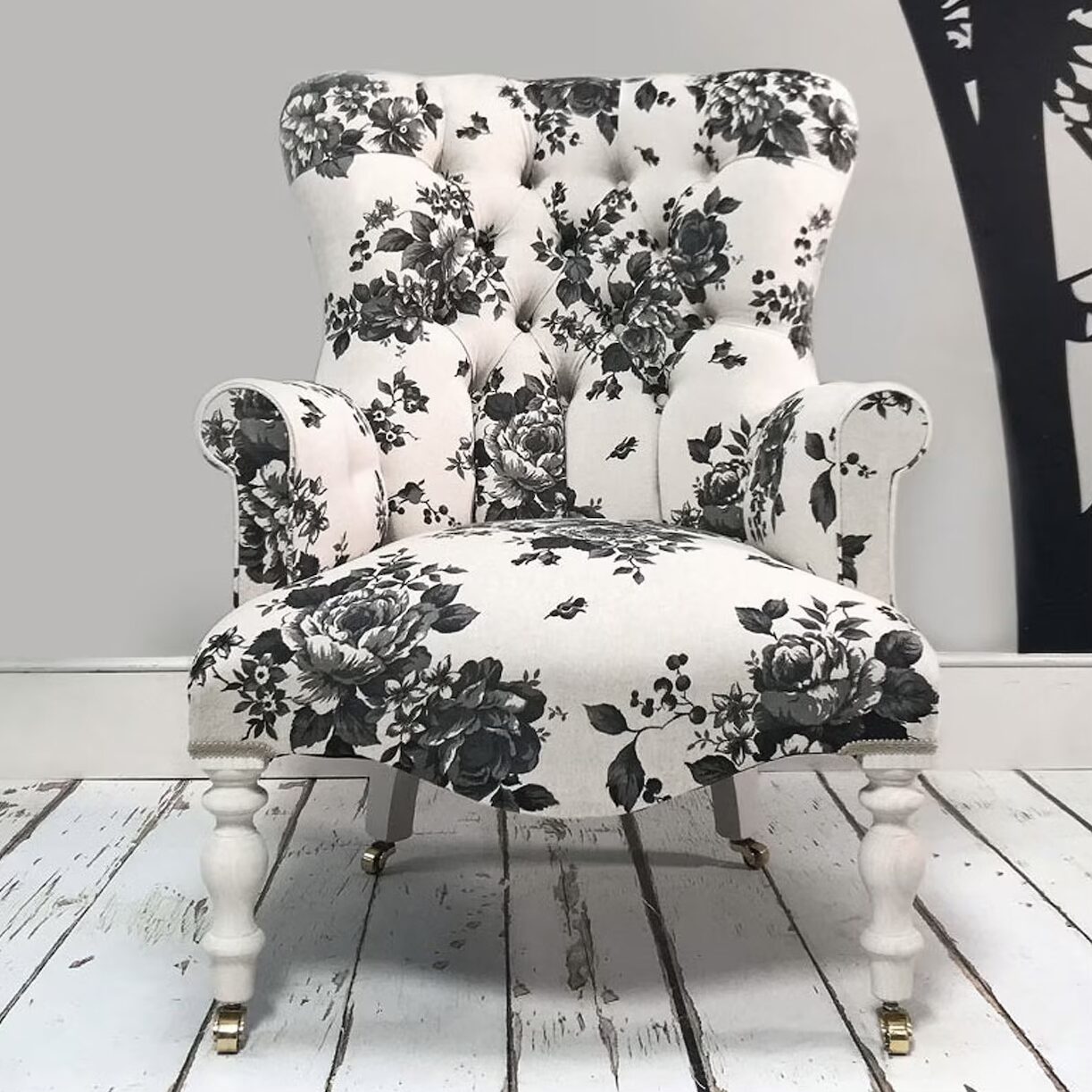
Georgia Rose Accent Chair
Classic wingback styling meets elegant monochrome florals for a timeless statement piece.
Shop chair
Animal Print Accent Chairs

Tan leopard on a red spindle frame, for retro drama with real character

Classic caramel leopard in clean lines, the easy way into animal print

Graphic zebra, gold fringing and a swivel base make it pure maximalist glamour
Leopard print is the most committed pattern in this guide — there is no quiet version of it, no way to make it recede. That’s precisely its appeal. One leopard chair in a room that’s otherwise solid and neutral becomes the entire personality of the space.
The distinction between tan leopard and monochrome leopard is worth thinking about before buying. Warm tan and caramel tones sit naturally in rooms with wood, brass and earthy textiles — they feel collected and slightly bohemian. Monochrome leopard reads colder and more graphic, better suited to darker, more dramatic schemes.

Against Down Pipe or Studio Green, a leopard chair doesn’t just survive the competition — it thrives on it. Dark walls give animal print the theatrical backdrop it’s looking for, and the contrast between the organic, painterly pattern and a deeply saturated wall colour is one of the more distinctive combinations in contemporary interiors. It’s a look rooted in retro interior design — maximalist, decade-informed, and completely unafraid.
Animal print works particularly well at the foot of a bed, where a pair of chairs creates a sense of occasion without requiring much floor space. It’s an easy way to bring drama into a grey bedroom scheme without touching the walls. It also suits reading corners and snugs — spaces that are allowed to have a stronger personality than the main living room.

Styling note: The most common mistake with leopard print is over-accessorising around it. The chair is the statement. Keep everything else — cushions, throws, side tables — in solid colours pulled from the chair’s ground tone.
Accent Chairs in the Bedroom
A patterned accent chair in a bedroom does something a plain upholstered one rarely manages — it gives the room a second focal point beyond the bed. Placed in a corner, beside a window or at the foot of the bed, it signals that the room has been thought about rather than simply furnished.
The bedroom is also one of the more forgiving spaces for pattern. Without the competing visual demands of a living room — sofa, rug, curtains, artwork all in play simultaneously — a patterned chair can breathe. A print that might feel busy in a sitting room reads as considered and personal in a bedroom.

Tone-on-tone is a particularly successful approach in the bedroom. Here, a pink textured chair against Pink Ground walls creates depth through surface rather than contrast — the pattern present but not insistent, which suits a space built around rest. This kind of heirloom, beamed-ceiling setting shares a lot with our cottage bedroom ideas, while the tonal restraint is a trick worth borrowing for a beige bedroom scheme too — pattern that adds texture without raising its voice.
The scale of the chair matters more in a bedroom than anywhere else. A large wingback or generously proportioned armchair can overwhelm a smaller room; a compact tub or slipper chair keeps the pattern without claiming too much floor space.

Pattern doesn’t always mean print. A woven or strapped chair brings its own quiet repeat — structural rather than surface, but no less considered as a design choice.
Styling note: A bedroom accent chair works hardest when it has somewhere to look — positioned to face the room rather than pushed into a corner as an afterthought. Give it a small side table or lamp for company and it becomes a destination rather than an overflow seat — the kind of detail that elevates bedroom ideas from functional to considered.
Designer Patterned Accent Chairs
Pattern has always been central to the most ambitious furniture design — not applied as decoration but built into the object’s fundamental logic. These are chairs where the pattern and the form are inseparable: remove one and the other stops making sense.
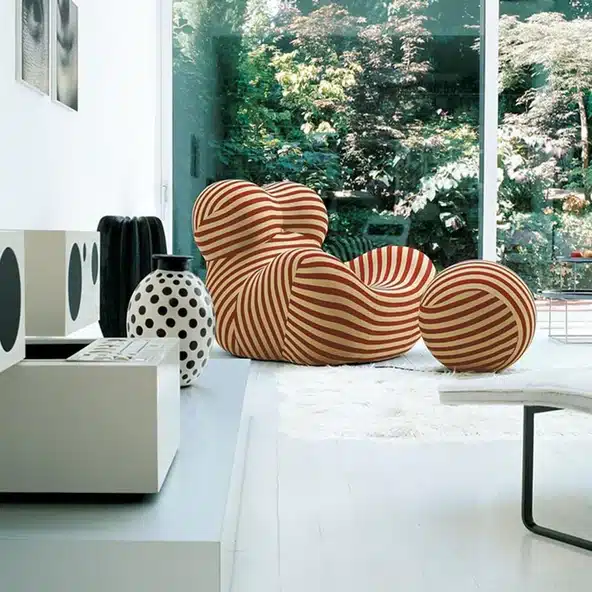
The B&B Italia Serie Up 2000 by Gaetano Pesce is the most radical example. The bold beige and orange stripe wraps a form that defies conventional chair geometry — organic, almost bodily, and immediately recognisable. Designed in 1969 and still in production, it is one of the few chairs that looks as contemporary now as it did on its first appearance.
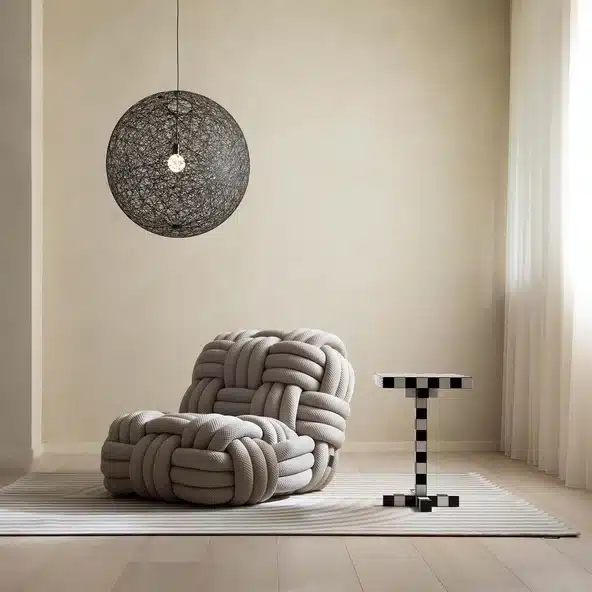
The Moooi Knitty takes a different approach — here the pattern is structural rather than applied. The oversized knotted rope construction creates a surface of infinite texture and movement, with no two angles looking quite the same — a quality it shares with the unique side table alongside it. It sits in a room the way sculpture does: as an object to be considered from all sides.
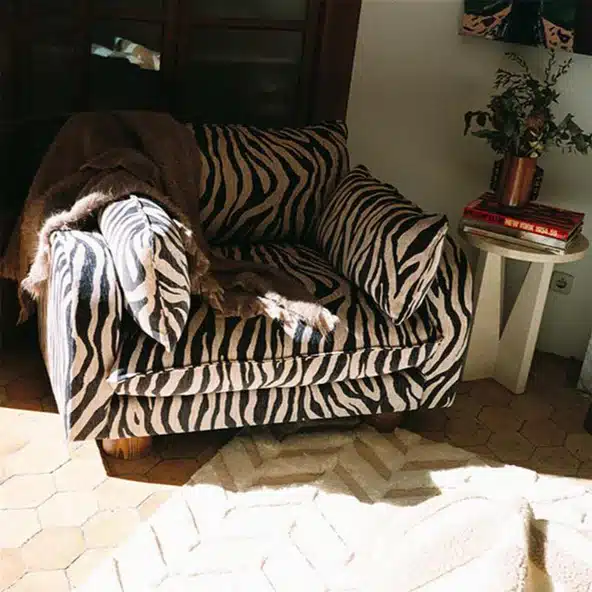
Dusty Deco’s zebra print pieces occupy the space between investment furniture and maximalist statement. The Miles armchair and loveseat carry the print at a scale that makes the pattern feel immersive rather than decorative — this is animal print operating at full volume.
Styling note: Designer chairs at this level work best given space and context. A plain wall, a considered rug, one or two complementary objects — the chair should be the room’s most interesting thing, not competing with other strong pieces for attention.
How to Style a Patterned Accent Chair

The most common mistake with a patterned accent chair is treating it as an island — placed in a corner and left to fend for itself. Pattern draws the eye, and the eye wants to know where to travel next. The most convincing rooms give it somewhere to go.
Let one pattern lead. A patterned accent chair works best as the room’s only significant pattern. A patterned sofa alongside a patterned chair is a considered creative choice that takes skill to pull off; for most rooms, one patterned piece with solid-colour companions is the more reliable route.
Echo, don’t repeat. Pick up one or two colours from the chair’s fabric — not all of them — and carry those tones into the surrounding textiles and accessories. A single cushion in a colour pulled from the chair’s ground, a rug that echoes its secondary tone: these small repetitions are what make a room feel deliberately designed.
Ground the pattern with texture. Printed or woven fabric is a flat surface relative to the rest of a well-dressed room. Give it company: a jute rug, a rough linen throw, a piece of turned wood, a ceramic pot. Texture absorbs visual energy and prevents pattern from feeling restless.
Think about scale. A large-scale botanical or oversized geometric print needs physical space to read properly — a small, low-ceilinged room will feel swamped by it. In compact spaces, a smaller repeat or a contained pattern — narrow stripe, tone-on-tone jacquard — brings interest without overwhelming. For more on working with limited square footage, see these small living room ideas.
Consider the room’s light. Dark patterned chairs in a poorly lit room can disappear; pale or bright patterns in strong light will amplify. Velvet and textured patterns are particularly sensitive to direction of light — they shift character between morning and afternoon in a way that printed fabrics do not.
Position the chair deliberately. An accent chair placed in the corner of a room often reads as an afterthought. Angled slightly towards the sofa, placed at a window, or positioned as part of a proper reading nook with a side table and lamp, it becomes intentional — a moment in the room rather than a leftover.
Frequently Asked Questions
Do patterned accent chairs need to match the sofa?
No — and in most rooms, they shouldn’t. The point of an accent chair is to add something the sofa doesn’t: contrast, pattern, a different silhouette or a pop of personality. The relationship that matters is tonal rather than matching: the chair’s colours should feel at home in the same palette as the sofa, without replicating its fabric or finish. A neutral sofa paired with a boldly patterned chair is one of the most reliable combinations in residential interiors.
What pattern works best in a small room?
Smaller rooms suit contained, tighter-repeat patterns rather than large-scale motifs. A narrow ticking stripe, a small geometric or a subtle jacquard will read as texture from a distance — adding visual interest without dominating the space. Very large florals or oversized botanicals tend to feel overpowering in compact rooms; save them for spaces with height and floor area to absorb them.
Can two different patterned chairs work together?
Yes, with the right framework. The most dependable approach is to choose two chairs with a shared colour — even if the patterns are entirely different in character — and keep everything else in the room solid or neutral. A striped chair and a floral chair can coexist comfortably if both pull from the same underlying palette. Mixed patterns work best when the scales are different: one large-scale pattern alongside one smaller or more contained one prevents the two from competing directly.
Should accent chairs be darker or lighter than the sofa?
Neither rule is absolute. A darker patterned chair beside a pale sofa creates contrast and makes the chair feel more dramatic and deliberate. A lighter chair beside a darker sofa softens the composition and feels less confrontational. What tends to work less well is a patterned chair that’s very close in both tone and weight to the sofa — the chair loses its purpose as an accent when the two pieces blend.
How do I stop a patterned accent chair looking busy?
The simplest fix is to reduce pattern elsewhere. If the chair is the most patterned piece in the room, it will read as a considered statement. If it’s competing with a patterned rug, patterned cushions and a busy wallpaper, it contributes to noise rather than character. Strip the surrounding textiles back to solids, keep the rug in a plain or subtly textured weave, and let the chair earn its place as the room’s one strong pattern moment.
What is the difference between an accent chair and an armchair?
The terms overlap — all accent chairs are armchairs in the structural sense, but not all armchairs function as accent chairs. An armchair is defined by its form: upholstered seat, back and arms. An accent chair is defined by its purpose: it’s chosen specifically to add visual interest, contrast or character to a room rather than to match the main seating. A patterned accent chair is typically bolder in fabric, more distinctive in shape or more decorative in detail than a standard armchair — it’s the piece a room is styled around, rather than the piece that disappears into it.
Disclosure: Some links in this article may be affiliate links. If you purchase through them, Artisan Haus may earn a small commission at no extra cost to you.