
Pleached trees are one of the most elegant solutions in garden design — a living screen that offers privacy, structure and year-round beauty without swallowing your garden whole. Whether you’re working with a narrow plot, a formal garden scheme, or simply want to divide space with something more interesting than a fence, pleached trees deliver in a way few other planting choices can.

What are pleached trees?
Pleached trees are trained to grow on a flat, horizontal plane, with their branches woven together along a framework of canes or wires to form a raised canopy. The result is a row of clear stems topped by a dense, rectangular screen of foliage — architectural, sculptural, and surprisingly versatile.
The technique is centuries old, rooted in formal European garden design, and has enjoyed a significant revival in contemporary British gardens where privacy is prized and space is often limited.
Why choose pleached trees?
Unlike a solid fence or wall, pleached trees bring movement, seasonal change and wildlife value to your garden boundary. They’re one of a number of effective screening plants for privacy, offering structure and concealment without the starkness of traditional fencing. In summer, a row of pleached hornbeam creates a dense green wall that hums with insect life.
They work equally well in formal and relaxed settings. A row of pleached trees can frame a view, screen a neighbour’s window, create a sense of enclosure around a dining terrace, or punctuate a longer border with rhythm and repetition.
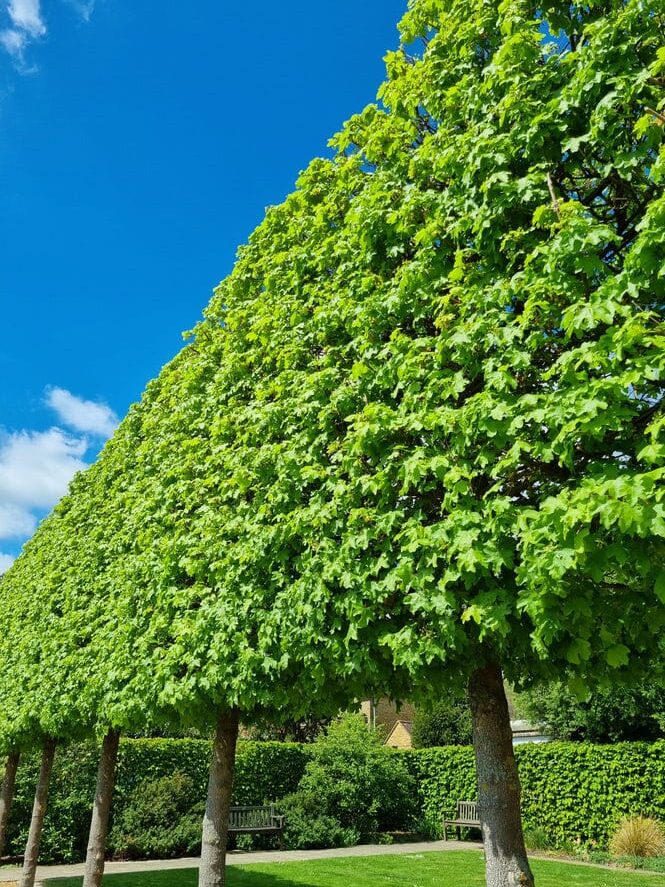
The best pleached trees for UK gardens
Pleached hornbeam (Carpinus betulus)
Hornbeam is the classic choice for pleaching in the UK, and for good reason. It’s hardy, fast-growing, and tolerates a wide range of soil conditions. In summer it carries fresh green, ribbed leaves; in autumn those leaves turn golden before fading to a warm russet brown — and crucially, hornbeam holds its dead leaves through winter, giving year-round screening even without its green canopy. It responds beautifully to clipping and is well suited to formal garden schemes.
Pleached beech (Fagus sylvatica)
Beech shares hornbeam’s habit of holding its autumn leaves through winter, making it another excellent choice for year-round privacy. The leaves emerge in spring as a luminous, almost translucent green before deepening through summer. Beech prefers well-drained soil and is particularly well suited to chalky or sandy ground.
Pleached cherry laurel (Prunus laurocerasus)
For an evergreen option, cherry laurel is one of the most popular choices. Its large, glossy leaves create a dense, lush screen, and it grows quickly once established. It tolerates shade better than many pleached species, making it useful in more sheltered positions. Clip once or twice a year to keep the canopy tight.
Pleached red robin (Photinia x fraseri ‘Red Robin’)
Red robin brings colour as well as structure. Its new growth emerges a vivid scarlet before maturing to deep green, giving the pleached canopy a two-tone quality that’s particularly striking in spring. It’s evergreen, reasonably fast-growing, and works well in both traditional and contemporary garden settings.
Pleached evergreen oak (Quercus ilex)
For something more substantial and long-lived, the evergreen oak is an outstanding choice. It’s slower growing than laurel or red robin but develops into a beautifully dense, dark green screen with real presence. Well suited to coastal and urban gardens, it’s also more drought-tolerant than many alternatives once established.
Pleached olive (Olea europaea)
In sheltered, south-facing gardens, pleached olives offer something genuinely different — silvery foliage, gnarled stems and a distinctly Mediterranean mood. They need good drainage and a warm, protected position to thrive in the UK, but in the right setting they’re spectacular.
How to plant pleached trees

Pleached trees are typically sold already trained on a bamboo frame, ready to slot into position. Spacing depends on the species and the size at purchase, but as a general guide, plant trees 1.5 to 2 metres apart to allow the canopy panels to knit together over time.
Choose a position that suits your species — most pleached trees prefer full sun to partial shade and well-drained soil. Dig a generous planting hole, incorporate some well-rotted organic matter, and stake the trees firmly against their supporting framework. Water thoroughly and regularly in the first season; establishing a good root system is the priority before the canopy really takes off.
A permanent framework of posts and horizontal wires will support the trees as they grow. The bamboo canes supplied with nursery-grown specimens are a starting point, but a more robust structure will serve the trees better in the long term.
How to care for pleached trees
Clip pleached trees once or twice a year — once in late spring after the first flush of growth, and again in late summer. The aim is to maintain the flat, rectangular canopy while encouraging density. Use sharp, clean secateurs or hedging shears and work methodically across the face of each panel.
Tie in any new growth that’s heading in the right direction and remove any shoots that are crossing or growing outward from the plane. Over time, the branches will knit together and the framework becomes largely self-supporting.
Feed in spring with a balanced, slow-release fertiliser to support strong, healthy growth, and mulch around the base of each tree to retain moisture and suppress weeds.
Do pleached trees grow taller?
This is one of the most common questions. Pleached trees will continue to grow upward if left unclipped, but regular pruning keeps them at your chosen height. Most gardeners maintain their pleached trees at a fixed height — typically between two and four metres — by removing the leading shoot once the desired height is reached and keeping the top clipped level each season.
How much do pleached trees cost in the UK?
Pleached trees represent a significant investment compared to hedging plants, but they deliver an instant impact that a hedge cannot. Prices vary considerably by species and size. Smaller specimens on a 120cm clear stem typically start from around £80–£120 each; larger, more mature trees on a 180–200cm stem can run to £250–£500 or more. Buying in a row of five or more often attracts a nursery discount, and it’s worth contacting specialist growers directly for larger quantities.
FAQs
What is the fastest-growing pleached tree?
Cherry laurel and red robin are among the fastest-growing pleached options for UK gardens, typically putting on 30–45cm of growth per year in good conditions.
Can pleached trees be grown in pots?
Yes, though they require large containers, consistent feeding and regular watering. This makes them a practical option for roof terraces and urban gardens where planting in the ground isn’t possible.
How far apart should pleached trees be planted?
As a general guide, plant pleached trees 1.5 to 2 metres apart, centre to centre. Closer spacing gives faster coverage; wider spacing suits larger-growing species.
Are pleached trees high maintenance?
Not especially. Two clips per year and an annual feed is all most established pleached trees require. The first couple of seasons after planting demand more attention as the roots establish and the canopy fills out.
What is the difference between pleached and espalier trees?
Espalier trees are trained flat against a wall or fence in a tiered, branching pattern. Pleached trees are freestanding, trained on a framework of posts and wires with a clear stem beneath the canopy. Both techniques create a flat plane of growth but serve different purposes in the garden.

For a more traditional, low-maintenance approach to garden boundaries, rustic fencing offers an alternative to living screens — though it won’t provide the same wildlife value or seasonal interest that pleached trees bring.