
Coastal interior design is less about literal seaside references and more about how a room feels — the palette of the British coastline brought indoors with restraint. Done well, the anchors and shells are incidental details in a scheme that would hold up without them.
The colours that define it are the ones you actually see at the coast: the blue-grey of a overcast sea, the chalky white of a rendered cottage wall, the warm sand of a low-tide beach. Farrow & Ball’s range captures this better than most — shades like Selvedge, Dix Blue and Parma Gray sit in exactly that register, soft enough to feel calm, characterful enough to feel considered.
In this guide we cover the Farrow & Ball colours that work best for an coastal interior, with real rooms across bedroom, living room and bathroom — plus the textures, furniture and accessories that complete the look without tipping it into theme.

Coastal Paint Colours: Farrow & Ball
The colours that define a coastal interior sit in a specific register — blue-greys, chalky blue-greens and soft, chalky neutrals that shift with the light rather than announce themselves. Farrow & Ball’s range has more of these than any other British paint brand, which is why it dominates coastal interiors done well.
These are the shades that work hardest:
Parma Gray is the most versatile of the group — a pale, chalky blue that reads almost neutral in low light but lifts noticeably in sun. It works on walls, woodwork and ceilings equally well, as the bedroom above demonstrates.

Selvedge sits darker and moodier — a blue with enough grey to feel grounded rather than bright. On a shiplap or panelled wall it’s particularly strong, deepening the texture of the surface rather than flattening it.
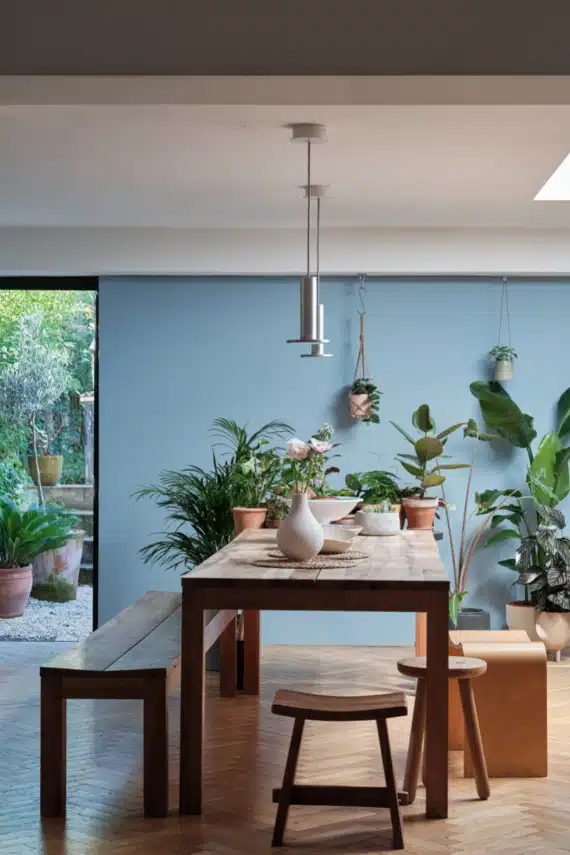
Lulworth Blue is the most traditional choice — a straightforward sky blue that works on front doors, kitchen cabinetry and in rooms that get strong natural light.
Dix Blue is the warmest of the coastal blues — it has a green lean that edges it toward the sea rather than the sky. It handles a south-facing room better than most blues without losing its coastal character.
Cook’s Blue steps up in depth and confidence — closer to a classic blue than a grey-blue, and particularly good in bathrooms where the depth of the colour can anchor a white suite without competing with it.
These hues work just as well in modern homes as they do in period properties, offering versatility while staying true to coastal interior design principles.
Coastal Living Room

The living room is the easiest place to tip a coastal scheme into cliché — too many nautical props and it reads like a holiday let rather than a home. The key is to let the paint colour and natural materials do the work, and keep the accessories restrained.
This open-plan living room by @neufoctobre shows how well Dix Blue handles a modern coastal scheme. The colour has enough green in it to feel connected to the sea without reading as a straight blue-green — it sits confidently against the oak slat panelling and integrated shelving without competing with it. The cream bouclé sofa and large petal ceiling light add warmth and texture, while the round marble dining table brings the kind of natural variation that prevents the scheme from feeling flat.
What makes this room work is the discipline of the material palette — oak, cream, marble and blue, nothing else. The slat panelling in particular anchors the television wall in a way that feels architectural rather than decorative — for more on how to achieve this look, our guide to wood panel TV wall ideas covers every style from shiplap to slat.
For a coastal living room in a period property, the same principles apply with slightly different materials — replace the oak slat with tongue and groove, swap the bouclé for linen, and consider Parma Gray or Selvedge in place of Dix Blue for a softer, more weathered result.

A rattan TV cabinet is a brilliant way to introduce texture into a coastal living room while keeping the space feeling calm and uncluttered. The woven fronts soften the look of the television, while the pale timber and stone backdrop echo sandy beaches and sun-bleached cliffs.
Coastal Kitchen and Dining
The kitchen is where coastal interior design is easiest to get wrong — too much blue and it tips into themed; too little and the coastal register disappears entirely. The key is in the material palette rather than the paint colour alone.

This kitchen-diner shows the balance well. The cabinetry sits in that particular blue-grey that reads differently across the day — closer to navy in the evening, closer to slate in morning light — while the AGA, brass hardware and oak dining table pull the scheme firmly into warm, lived-in territory. The zellige tile backsplash adds the handmade texture that separates a considered coastal kitchen from a standard blue one.
The dining end of the room does as much work as the kitchen itself. The oak trestle table with brass-legged chairs, bouclé seating and clear glass pendants creates an open, light-filled space that feels connected to the courtyard garden — exactly the indoor-outdoor quality that defines coastal living at its best.
For paint, this cabinet colour sits closest to Farrow & Ball’s Hague Blue — dark enough to feel grounded, warm enough to stay inviting. Paired with Porcelanosa’s zellige-effect tiles and brass hardware throughout, it’s a complete coastal kitchen scheme that requires nothing else.
Coastal Bathroom

The bathroom is where coastal interior design can be pushed furthest without tipping into theme. The combination of painted tongue and groove, a freestanding bath and patterned floor tiles is one of the most reliably successful formulas in British bathroom design — and Cook’s Blue by Farrow & Ball is one of the best colours to build it around.
This bathroom by @studiofantoush takes that combination and executes it with real confidence. Cook’s Blue on the tongue and groove below the dado gives the lower half of the room depth and character, while the pink-toned roll-top bath sits against it in a way that feels unexpected but completely right — the warm pink pulling the blue away from anything cold or stark. The encaustic patterned floor tiles tie the two colours together and add the kind of handmade texture that lifts the whole scheme. The tongue and groove itself is worth noting — painted panelling in a bathroom is one of the most practical ways to add character to a wet room, and one of the easiest to retrofit. Our guide to bathroom wood panelling covers heights, materials and paint finishes in detail.
The botanical prints above the dado and the Egon Schiele print keep the walls from feeling bare without cluttering the space. This is a bathroom that has been put together with care — every element earns its place.
For walls, a warm neutral above the dado — the Pink Ground visible in the Selvedge hallway earlier works on exactly this principle — prevents the blue from dominating and gives the eye somewhere to rest.
For a smaller coastal bathroom or cloakroom, wallpaper does the work that paint does in a larger space. Farrow & Ball’s Yukutori pattern — an abstract motif that reads like birds in flight over water — brings the coastal register in a single wall without requiring any other decoration. Paired with brass hardware and a clean white basin, it’s a complete scheme in itself.

Coastal Bedroom
The bedroom is where coastal interior design works hardest — it’s a room that already asks for calm, and the right paint colour and bedding can achieve that without any further effort.

Image: @theoxtobyburrow / Farrow & Ball
Coastal furniture works best when the shapes are simple and the lines feel relaxed rather than fussy. In this Farrow & Ball bedroom, a panelled headboard, slim bedside table and neatly layered linens create an easy, understated elegance that still feels wonderfully comfortable.
School House White and Drop Cloth on the walls and woodwork offer a warm neutral backdrop, allowing the inky blue cushions and natural wood tones to echo the colours of the coast.
Coastal Home Decor
Coastal decor ideas don’t need to be literal to work — the best coastal home decor takes its cues from the palette and materials of the British coastline rather than its obvious symbols. A wave canvas above a dining table, a pair of rattan side tables, a driftwood candlestick on a mantel — each of these adds coastal character without announcing it.

For coastal wall decor, the QuaysFineArt wave canvas is one of the strongest options available — a circular oil painting in soft blues and white foam that works above a dining table or in a hallway, and anchors a coastal colour scheme without competing with it.

For texture and surface, the bamandbloom sea-glass mosaic rattan tables bring the tidepool blues of the paint palette into the furniture layer — lightweight enough to move between rooms, versatile enough to work as sofa sides, bedside tables or beside a freestanding bath.
Coastal Baskets and Trays for Soft Storage
Natural baskets and trays are perfect for a relaxed coastal interior – they add texture, hide clutter and keep everyday pieces close at hand.


The accessories that complete a coastal interior are the ones that feel collected rather than bought as a set — driftwood candlesticks, glass buoys, oyster shell candles, a seagrass basket. None of these are coastal in an obvious way individually, but together they create the layered, natural quality that defines coastal decor done well. The coastal decor accessories that earn their place are the ones that could sit happily in any well-considered interior — the coastal quality comes from the context around them, not the object itself.
Coastal Accessories: Small Pieces with Big Impact
A few well-chosen accessories can instantly sharpen a coastal interior – think driftwood, sea-glass blues
and natural textures that echo the shoreline without feeling theme-y.

a living room or bedroom.
Shop Fine Stripes Rug

first impression at any entrance.

shelves, mantels or console tables.
Coastal Wall Art
For a more striking design feature, explore sculptural wall art that embraces movement and marine life. These handcrafted eco-resin plaques by LamornaStudio on Etsy are full of coastal soul and artisan detail. Choose from swirling jellyfish or a statement octopus — each piece offers gentle texture and a nod to the ocean without overpowering your space. Their soft white finish and organic shapes blend beautifully with neutral or blue-toned interiors, bringing natural rhythm and calm to a seaside-inspired scheme.


Discover more coastal wall décor at LamornaStudio on Etsy.
Explore our curated edit of coastal décor — handpicked finds from independent makers and small shops.
Coastal Interior Design: The Takeaway
Coastal interior design isn’t about theme; it’s about feeling—light, calm, and quietly refined. Start with a soft palette of sands and sea blues, add natural textures (timber, rattan, seagrass), then layer in a few sculptural moments—art, coral-inspired pieces, driftwood, or woven lighting—to bring depth without clutter. Keep silhouettes clean, fabrics breathable, and finishes matte or lightly weathered so the look stays effortless.
If you’re updating a single room, choose one anchor—an ocean-toned rug, a wave-inspired artwork, or a cane chair—and build around it with tactile accents. Small swaps like striped cushions, glass buoys, or a driftwood candlestick quickly shift a space toward coastal decor while staying polished.
Coastal Decorating FAQs
What is coastal interior design style?
A soft, natural approach to decorating that draws from the seaside — featuring neutral tones, gentle blues, natural materials, and airy layouts.
What is the difference between beachy and coastal décor?
Coastal décor is elegant and timeless; beachy décor is often more casual or kitsch. Coastal style avoids overtly themed accessories in favour of sophisticated materials and subtle seaside references.
How do you decorate a home with a coastal theme?
Use a base of pale, airy colours. Introduce wood, linen, and rattan textures. Add accessories like coral, seascape art, and blue-striped rugs. Keep the look uncluttered and serene.
What are the key coastal interior design trends for 2026?
- French blue and seafoam green tones
- Natural wood sideboards and cane accents
- Faux coral and shell-inspired ornaments
- Layered white-on-white schemes with textured throws
- Softly abstract oceanic artwork