
The dining room has had a quiet renaissance. After years of being absorbed into open-plan living, it’s back — and this time it means business. Richer colours, more tactile surfaces, lighting that earns its place, and a table set as though someone actually thought about it.
Whether you’re working with a dedicated room or a shared kitchen dining room, the way you style it changes everything about how it feels to sit down and eat. These dining room decor ideas sit alongside our broader guide to dining room ideas — covering everything from paint and lighting to table styling and wall treatments, with an eye on what actually works in real British homes.

Dining Room Paint Colours
The dining room is one of the few spaces where going darker actually makes sense. Most people use it in the evening, which means it can handle deeper, moodier tones that would feel oppressive in a room you spend all day in. This is the room to be bold.
Farrow & Ball’s Down Pipe is a masterclass in how to do dramatic without tipping into cold. Paired with warm wood tones and a sculptural globe pendant, it creates that cocooning quality that makes a dining room feel like a proper occasion. Railings takes a similar approach — a deep blue-grey that works particularly well with brass lighting and linen. If you’re working with a single wall rather than committing to all four, it’s one of the best colours for a dining room feature wall.


Fox Red is having a moment — and deservedly so. That rich terracotta wraps a dining room in a way that feels deeply inviting, especially by candlelight. It pairs naturally with white furniture and sculptural lighting, and sits beautifully alongside the kind of mid-century influenced pieces that are back in favour right now.
And if you want to try colour without going dark, Arsenic proves that a well-chosen green — here used on the ceiling of a crittall extension — can be just as impactful. The trick is committing to it.

Dining Room Lighting
Lighting is the single most transformative thing you can do in a dining room — and also the most commonly underestimated. The right pendant over a dining table changes everything: the scale of the room, the mood of a meal, how long people want to stay at the table.
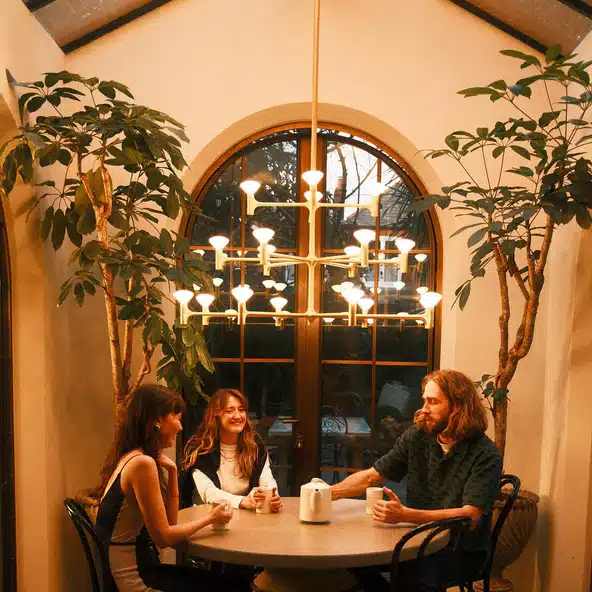
The pendant should sit roughly 70–80cm above the table surface. Too high and it loses intimacy; too low and it becomes an obstacle. For longer tables, a row of smaller pendants often works better than one large fixture — it distributes light more evenly and adds visual rhythm.
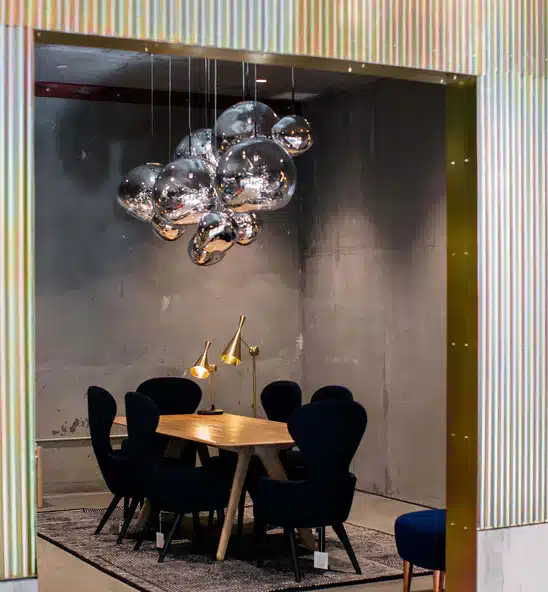
A brass statement chandelier like the Tala Root earns its place in a room that can handle the drama, while the Tom Dixon Melt cluster brings a moodier, more industrial edge that works beautifully against dark walls. The Atkin & Thyme Tula Trio — three amber glass globes on a single bar — is one of those pieces that looks far more expensive than it is, and the Nuura Anoli cluster adds a quieter, more refined take on the grouped pendant.
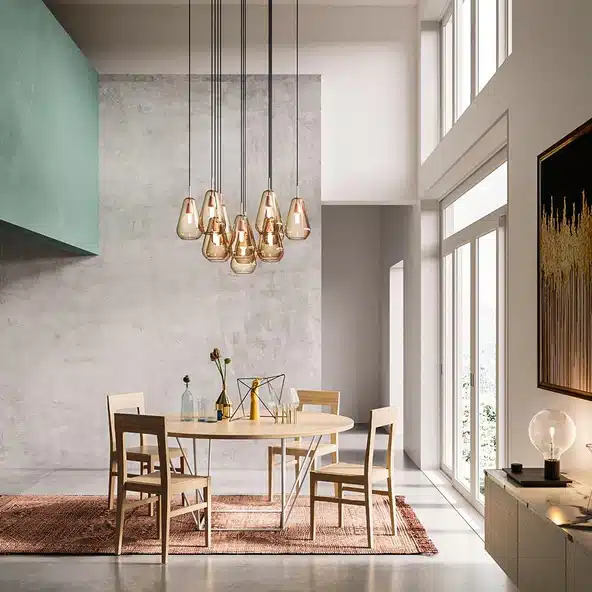
Beyond the pendant, layering matters. Wall lights or sconces on a dimmer bring the room down to a more human scale in the evening, and candles do the rest. Avoid relying on a single ceiling light without something warmer at eye level to balance it. For more inspiration across every room, see our full lighting ideas guide and dining room pendant lights.

Dining Room Table Styling
The way you set a table says a lot about how you want the meal to feel. There’s no single right answer — a relaxed supper with friends calls for something entirely different to a considered dinner party — but both deserve to be thought about.

For everyday dining, Royal Doulton’s Pacific collection is hard to beat. The mix of coastal patterns — dots, brush strokes, splashes — means no two place settings look identical, which gives the table an effortless, collected quality. It works on bare wood, with a simple linen runner, or layered with placemats and mismatched glassware. The kind of china that looks better the less formal you try to make it.

For something more deliberate, Wedgwood’s Vera Wang Luxe Graphite brings a quiet drama to the table. The stark graphite stripe against white bone china is architectural rather than decorative — it needs very little around it. Paired with crystal glassware and a single statement centrepiece, it lets the setting do the talking.
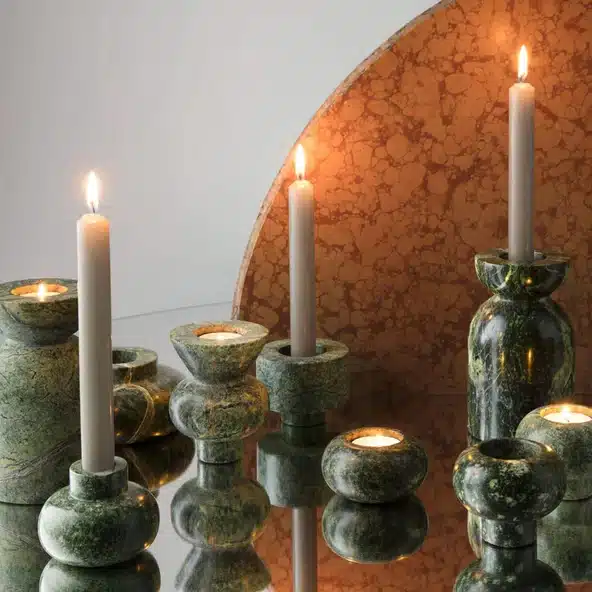
And the centrepiece matters more than most people give it credit for. A cluster of Tom Dixon’s Stone Stacking Candleholders in green — mixing tapers and tealights at different heights — creates that warm, flickering atmosphere that no overhead light can replicate. The rule is simple: vary the height, keep the palette tight, and leave space for the food.
Dining Room Wall Decor
The walls of a dining room are often the last thing people think about — and the quickest way to make the whole space feel considered or completely unfinished. A bare wall behind a sideboard is a missed opportunity; the right treatment there anchors the room.

Art is the most powerful tool. One large piece — properly scaled to the wall, not a small canvas floating in the middle of nowhere — makes a stronger statement than anything else. @cat_dal_interiors gets this exactly right: a single oversized figurative print above the sideboard against Farrow & Ball Bancha, and the room needs nothing else.

However a gallery wall can be just as effective, when it’s approached with genuine curation, rather than as a way to fill space. @gemmaberlyn’s dining room proves it — a Bancha ceiling dropping into Setting Plaster walls, with a tightly edited collection of framed prints that feels personal rather than decorative.

Panelling adds architectural interest without needing art at all. Farrow & Ball School House White on tongue and groove below the dado — as @lydiaallen_interiors shows beautifully — brings warmth and texture to a room while keeping the palette calm. Pair it with wall sconces on either side of a single artwork and the whole wall becomes a considered composition. For more ideas see our full guide to wall panelling ideas.

And don’t overlook smaller display moments. A floating shelf — particularly one with genuine craft behind it, like this checkerboard ash and walnut piece from ShelfAndObject — gives you a surface to layer objects, lean prints and change seasonally without committing to anything permanent.
Dining Room Furniture
The table is the room. Everything else — chairs, lighting, paint — exists in relation to it. Get the table right and the rest becomes much easier.
Scale is the first consideration. A table that’s too small for the room looks lost; one that’s too large makes the space feel cramped and difficult to move around. As a rule, leave at least 90cm between the table edge and the wall to allow chairs to be pulled out comfortably.

Solid wood remains the most versatile choice — it ages well, takes knocks, and works across styles from farmhouse to contemporary. Atkin & Thyme’s Reeves table, in solid oak with brass trestle legs, is a strong example of how warm wood tones and considered hardware can make a dining table feel genuinely special rather than simply functional.
Chairs don’t need to match the table — and often shouldn’t. Mixing a bench on one side with upholstered or occasional chairs on the other creates a more relaxed, collected feel. Boucle fabrics are having a sustained moment for dining chairs — they add softness to what can otherwise be a hard-edged room.

The sideboard earns its place in almost every dining room. Beyond storage, it’s a display surface, a drinks station and a way of grounding the room visually. It doesn’t have to be a traditional sideboard either — a bar trolley or console table styled with intention, as @scandinavian.interior shows against Farrow & Ball Drop Cloth, can be just as effective. A lamp, a sculptural vase, a bottle of something good. The wall behind it takes care of itself.
Small Dining Room Decor Ideas
A small dining room isn’t a compromise — it’s an opportunity to create something more intimate and considered than a larger space allows. The constraints force better decisions.
The table is where most people go wrong. An oversized table in a small room makes everything feel cramped and difficult to navigate. A round table is almost always the better choice in a compact space — it takes up less visual room, allows better flow around it, and feels more sociable. Where a rectangular table works better for the room’s shape, a fixed bench against a panelled wall — as @anewday_interiordesign shows beautifully against Farrow & Ball Dead Salmon — reclaims the floor space that freestanding chairs on all four sides would swallow. Tuck in a cushion, add a wall sconce above, and the corner becomes the best seat in the room.

Colour in a small dining room can go one of two ways. Painting everything in one tone — walls, woodwork and ceiling — makes the space feel cohesive rather than small. Or commit to a single bold wall behind the table to create depth and draw the eye. Dead Salmon with Pointing on the woodwork is a masterclass in the former: warm, layered and anything but neutral.
Edit ruthlessly. One piece of art rather than several. One considered light fitting rather than multiple sources competing for attention. In a small dining room every object needs to earn its place — but the ones that do make the room feel curated rather than cramped.
For more ideas see our full guide to small dining room ideas.
FAQs
What should I put in the middle of my dining table?
A centrepiece works best when it varies in height, texture and material. A cluster of candleholders at different heights, a single large vase with stems, or a low bowl with fruit or foliage all work well. The key is to keep it edited — one strong arrangement rather than several competing objects — and leave enough space for the food.
What is the 3-5-7 rule in interior design?
It’s a styling principle based on odd numbers. Group objects in threes, fives or sevens rather than pairs or even numbers — odd groupings feel more natural and less symmetrical. On a sideboard or dining table, three objects of varying heights will almost always look more considered than two or four.
How do you decorate a dining room?
Start with the bones — paint colour, lighting and a table that properly fits the room. From there, layer in chairs, a sideboard and wall treatment. Table styling and accessories come last. The most common mistake is trying to do everything at once; get the big decisions right first and the room will tell you what it needs.
What are dining room trends for 2026?
Moody, atmospheric rooms are having a strong moment — richer paint colours, warmer wood tones, layered lighting and tables styled as though they mean something. The dining room is being treated as a destination again rather than an afterthought.
What colour is best for a dining room?
There’s no single answer — but dining rooms handle deeper, richer tones better than most rooms because they’re used primarily in the evening. Farrow & Ball Down Pipe, Railings, Bancha and Fox Red all work beautifully. If you want something warmer and more neutral, Dead Salmon with Pointing on the woodwork is hard to fault.
What artwork should I put in my dining room?
One large piece scaled to the wall will almost always outperform a gallery of smaller prints. Figurative works, botanicals and abstract pieces all suit a dining room. Hang it at eye level — not too high — and if possible, position it where it catches the candlelight in the evening.
A well-decorated dining room doesn’t happen by accident — but it doesn’t require a complete renovation either. The right paint colour, a pendant that earns its place, a table that fits the room and a few considered objects on a sideboard will take most dining rooms further than any amount of accessories ever could.
The through line in every dining room that works is intention. Not perfection — intention. A room that feels as though someone thought about it, lived in it and styled it for the people who sit down in it.
For more inspiration explore our guides to dining room ideas, dining room lighting, dining room colour ideas and small dining room ideas.